
If you run a small business and want AI doing real work, you have three ways to get there: hire someone, bring in a fractional AI partner, or do it yourself. Each one can work. They cost very different amounts, and they fail in different ways. Here’s an honest comparison, with real numbers where they exist and our own prices on the table.
Option 1: Hire an AI person
A full-time hire gives you someone inside the business every day, and that has real value. It’s also the most expensive option by a wide margin.
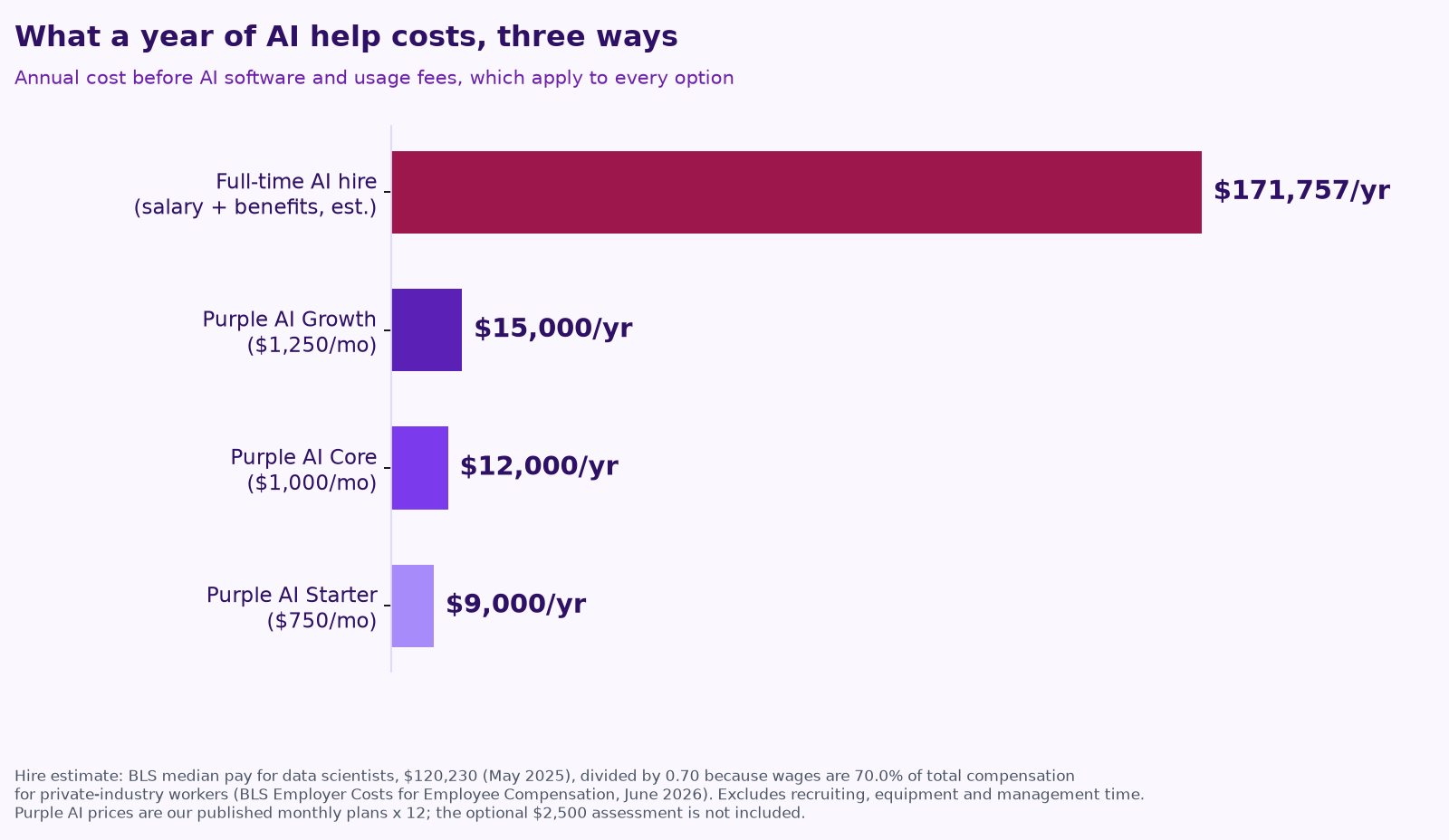
There isn’t a clean government job category for “AI implementation lead,” so the closest benchmark is data scientists. The U.S. Bureau of Labor Statistics puts their median pay at $120,230 a year (May 2025). Wages are only part of what an employee costs. For private-industry workers, wages and salaries make up 70.0% of total compensation in the BLS’s June 2026 data, and benefits are the other 30%. Gross the median salary up by that ratio and you get roughly $172,000 a year before recruiting, a laptop, software or your time managing them.
The bigger issue for a 10- to 50-person company is often fit, not price:
- The job is part-time. Once the first few workflows are running, the work becomes tuning and adding, not building full time.
- It’s a hard hire. “AI personnel/specialist” now shows up on the list of hard-to-fill salaried jobs in the 2025 AGC and NCCER workforce survey, where 92% of hiring contractors said filling positions is hard. Small firms compete with tech companies for the same people.
- One person is a single point of failure. If they leave, the know-how often leaves too.
When hiring makes sense: you have enough AI work for a full-time person across several departments, someone senior to manage them, and a budget that can absorb a six-figure salary.
Option 2: A fractional AI partner
“Fractional” means you get part of an experienced team’s time on a monthly plan, the way many small companies already use a fractional CFO or an outsourced IT firm. The partner sets up the agents, connects them to your tools, writes the instructions and checks, and keeps improving them.
Here’s what that costs with us, since you shouldn’t have to book a call to find out:
- Starter, $750 a month: one workflow or dashboard, such as daily reports or a weekly job-cost summary.
- Core, $1,000 a month: an ongoing agent team, our most popular plan.
- Growth, $1,250 a month: agents across several departments.
- Optional assessment, $2,500: a fast, deeper look at your workflows before you commit, with $1,000 credited to your first month.
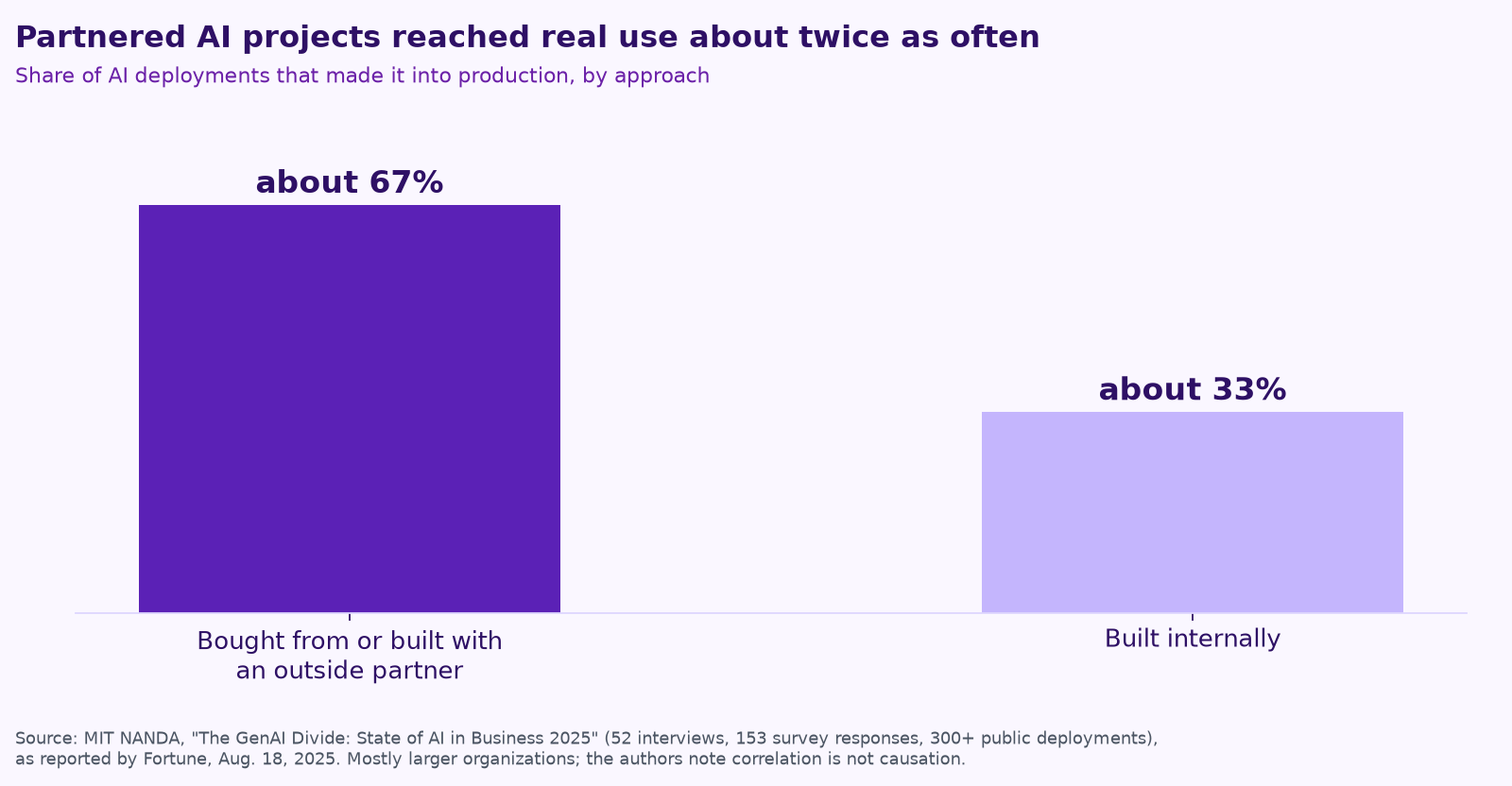
Price isn’t the only argument for outside help. MIT’s NANDA initiative studied how companies were rolling out generative AI in 2025 and found that tools bought from or built with outside partners reached real use about 67% of the time, compared with about a third for internal builds. Treat that as a direction, not a law. The sample was small and mostly larger organizations, and the authors note that correlation isn’t causation. But the reason they give rings true at any size: partners have usually done the integration work before.
The trade-offs, honestly: a fractional partner isn’t in your office every day, works across several clients and needs a clear owner on your side to answer questions and approve work. If nobody at your company can give it an hour a week, any option will stall.
When fractional makes sense: you know AI could save time, you don’t have the volume or budget for a full-time hire, and you’d rather pay monthly for working results than run a hiring process.
Option 3: Do it yourself
The tools are cheap. ChatGPT Business, for example, is $25 per user per month, or $20 billed annually, for a standard seat, and other major AI assistants price team plans in the same range. A 10-person team could have business-grade AI for a couple of thousand dollars a year.
The real cost is your time and the drift that comes with it. Most companies that “do AI” this way end up with a few people using a chatbot for one-off tasks and no workflow that runs the same way every week. ENR columnist Brantley Brumley saw exactly that when he polled contractors: almost everyone used AI, and almost nobody had a repeatable workflow (ENR, Nov 18, 2026). His point is that “most midsize contractors don’t need a full-time AI engineer,” but they do need one person who owns it.
When DIY makes sense: someone on your team is curious, has a few hours a week, and you’re starting with low-risk work like drafting and summarizing. It’s a perfectly good place to begin, and the checklist in our one-week AI assessment guide works whether or not you ever hire anyone.
Side by side
| Hire | Fractional partner | DIY | |
|---|---|---|---|
| Typical yearly cost | About $172,000 with benefits (BLS-based estimate) | $9,000 to $15,000 with our plans | Low software cost, plus your time |
| Time to first working workflow | Hiring time, then ramp-up | Weeks | Depends on who has the time |
| Biggest risk | Expensive, hard to find, one person leaving | Stalls without an owner on your side | Never gets past one-off chats |
| Best for | Larger firms with lots of AI work | Small teams that want working results monthly | Curious teams starting with low-risk tasks |
What you’re really paying for
The AI models themselves keep getting cheaper and more capable. When Anthropic released new Claude models on November 9, investor and founder Greg Isenberg wrote on X that agents working for hours on their own “basically gives every small business a night shift,” and predicted agencies would “start charging per deliverable instead of per hour.” Whatever you think of the hype, the direction is clear: the scarce part isn’t access to AI. It’s knowing which jobs to give it, writing down how your business does them, connecting the right tools and checking the work.
That’s true whichever option you choose. So before you compare prices, answer three questions:
- ☐ Which one or two jobs would we hand off first, and how many hours do they take today?
- ☐ Who on our team will own it, and do they have an hour a week?
- ☐ How will we know in 60 days whether it’s working?
If you can answer those, any of the three options can work. If you can’t, start there. For examples of first jobs, see 7 workflows a small contractor can hand to AI agents and where agents save hours for trades businesses.
Keep reading
- How to run an AI assessment for your small business in one week
- Give your AI agent a job, not a to-do list
- Your AI team shouldn’t copy your org chart
- AI agents vs. chatbots vs. automation: what a small business actually needs
- AI for property management: maintenance requests, leasing follow-up and owner reports
- How to keep a human in charge of AI agents
- Procore, ServiceTitan, Jobber and Buildertrend have AI now. Where does an agent team fit?
- Missed calls cost trades businesses jobs: AI answering, intake and follow-up done right
- AI for accounting and bookkeeping firms: close, client follow-up and document chase
- AI receptionists for contractors: Jobber vs. ServiceTitan vs. standalone tools
- A free AI use policy template for small businesses
- AI for construction estimating and takeoffs
- How to measure AI agent ROI with the hours-back method
- AI for HVAC maintenance agreements and renewals
- AI for construction safety documentation and toolbox talks
- AI for lien waivers and pay applications
- AI for roofing storm-season leads and claim reports
How we do this at Purple AI
Purple AI is an AI consulting firm for small businesses, and we start with construction and trades. We set up a small team of AI agents inside the tools you already use, give each agent one job, and keep a person in charge of anything that matters. Then we stay on to tune it as your business and the AI tools change.
The easiest first step is a free 15-minute AI mini-audit. We’ll look at where your week goes and name the one or two jobs we’d hand to an agent first. Book your mini-audit here.
If it’s a fit, ongoing plans are Starter at $750 a month (one workflow or dashboard), Core at $1,000 a month (an ongoing agent team, our most popular plan) and Growth at $1,250 a month (agents across several departments). If you want a deeper look first, there’s an optional $2,500 assessment, and $1,000 of it is credited to your first month.
Sources
- U.S. Bureau of Labor Statistics, Occupational Outlook Handbook: Data Scientists (median pay, May 2025).
- U.S. Bureau of Labor Statistics, Employer Costs for Employee Compensation, Table 1 (June 2026).
- Associated General Contractors of America and NCCER, 2025 Workforce Survey national results.
- Fortune, MIT report: 95% of generative AI pilots at companies are failing (Aug 18, 2025), on MIT NANDA’s “The GenAI Divide: State of AI in Business 2025.”
- OpenAI Help Center, ChatGPT Business overview (seat pricing, checked Nov 19, 2026).
- Brantley Brumley, ENR, Contractors Don’t Need an AI Strategy, They Need an AI Owner (Nov 18, 2026).
- Greg Isenberg (@gregisenberg), post on X about the Claude model launch (Nov 9, 2026).
Free checklist
Find 10 hours a week: the AI checklist for contractors
30 places construction and trades businesses lose time every week, and what an AI agent can take off your plate. On the page or as a printable PDF.
Get the checklist →