
If you’ve been told your business needs “a team of AI agents,” here’s a useful week of news to read first. On November 17, Wharton professor Ethan Mollick shared a new Anthropic article and summed it up bluntly: rather than “a sprawl of specialized subagents built by different teams, you often get better & cheaper results using one agent to do it all.” His post drew more than 2,000 likes and nearly 2,500 bookmarks, which tells you a lot of builders recognized the problem.
That doesn’t mean AI teams are a bad idea. It means the way most people picture them, with one bot per department passing notes to a “manager” bot, is often the wrong shape. The better rule for a small business: give each job one capable agent, and only split a job across several agents when the work truly comes apart into separate pieces. This post walks through what the research says, where the hard parts are, and how to apply it to a construction or trades business.
What Anthropic actually found
The article, “Building agents: When to fold subagents into your main agent loop”, comes from Anthropic’s Applied AI team, which helps large companies build agents. A “subagent” is a separate AI worker with its own instructions and tools that a coordinating agent hands work to. Anthropic still uses them. But across several enterprise deployments, the team writes, a single agent with “skills” (written procedures it loads when needed) frequently beat both a single giant prompt and a multi-agent design on quality, and often cost less and ran faster per task.
A few details stand out:
- One company had a dozen specialist subagents inside its customer-facing agent. That made a consistent, on-brand experience hard to maintain and added delays customers noticed.
- One customer that compared its multi-agent setup against a single agent loop saw roughly 2x faster runtime with the single loop.
- For many proposed designs, the feedback was that “one clear system prompt, 4-5 thin data tools, and firm output guardrails would cover most of the use case.”
The authors name the root cause directly: companies give each team its own subagent, and the AI design ends up as a copy of their org chart. Every team adds a sentence to the shared instructions (they call the result a “Frankenprompt”), details get lost in handoffs, and nobody owns the quality of the whole thing.
“Too often we see enterprises give each team or problem type its own subagent, with the agent architecture becoming a copy of their org chart.”
— Anthropic, Building agents: When to fold subagents into your main agent loop
The research agrees: it depends on the shape of the work
This isn’t one company’s opinion. In a controlled study, researchers at Google tested single agents against four kinds of agent teams across hundreds of configurations, holding tools, prompts and token budgets steady so the only difference was the team design (Kim et al., arXiv:2512.08296; Google Research summary).
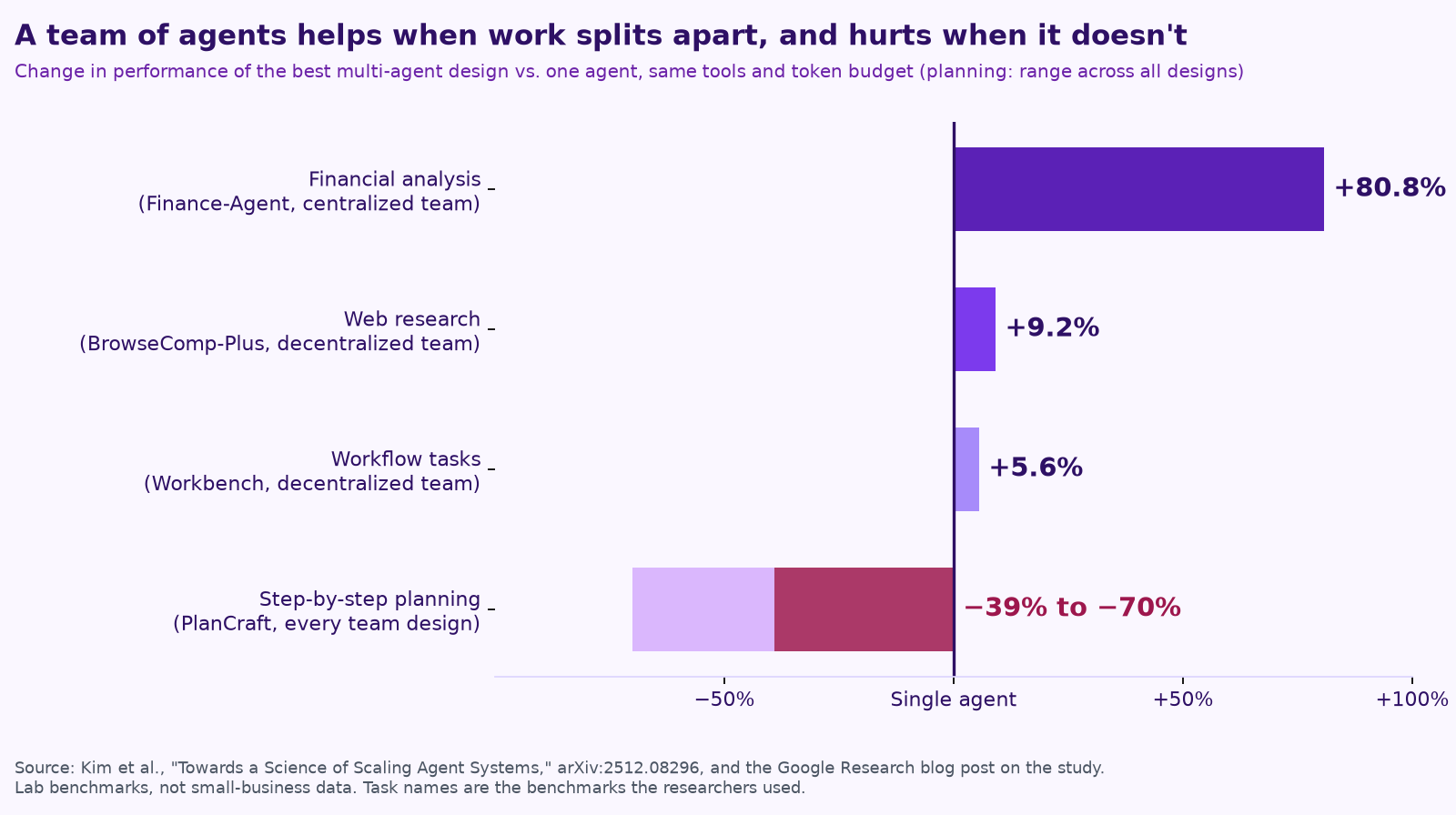
The pattern is clear. When work splits into independent pieces, like analyzing revenue, costs and market comparisons at the same time, a coordinated team improved results by about 81%. When work is a chain of steps where each one depends on the last, every team design they tested made things worse, by 39% to 70%. The researchers’ explanation: passing messages between agents eats up the budget the agents need for actually thinking, and the reasoning gets broken into pieces.
Two more findings matter for owners:
- Unchecked teams multiply mistakes. Agents working in parallel without anyone checking their work amplified errors 17.2x in the study. With a coordinator reviewing results, that dropped to 4.4x. If you do build a team, someone (or something) has to check the work.
- Extra agents help less once one agent is already decent. The paper reports diminishing or even negative returns from adding agents once a single agent was already scoring above roughly 45% accuracy on its own.
Teams cost more to run, too
Anthropic is not anti-team. Its own Research feature uses a lead agent with helper agents searching in parallel, and in its write-up of that system the company reports the team beat a single agent by 90.2% on its internal research eval. Research is the ideal case: lots of independent searches that can run side by side. But the same post is honest about the bill.
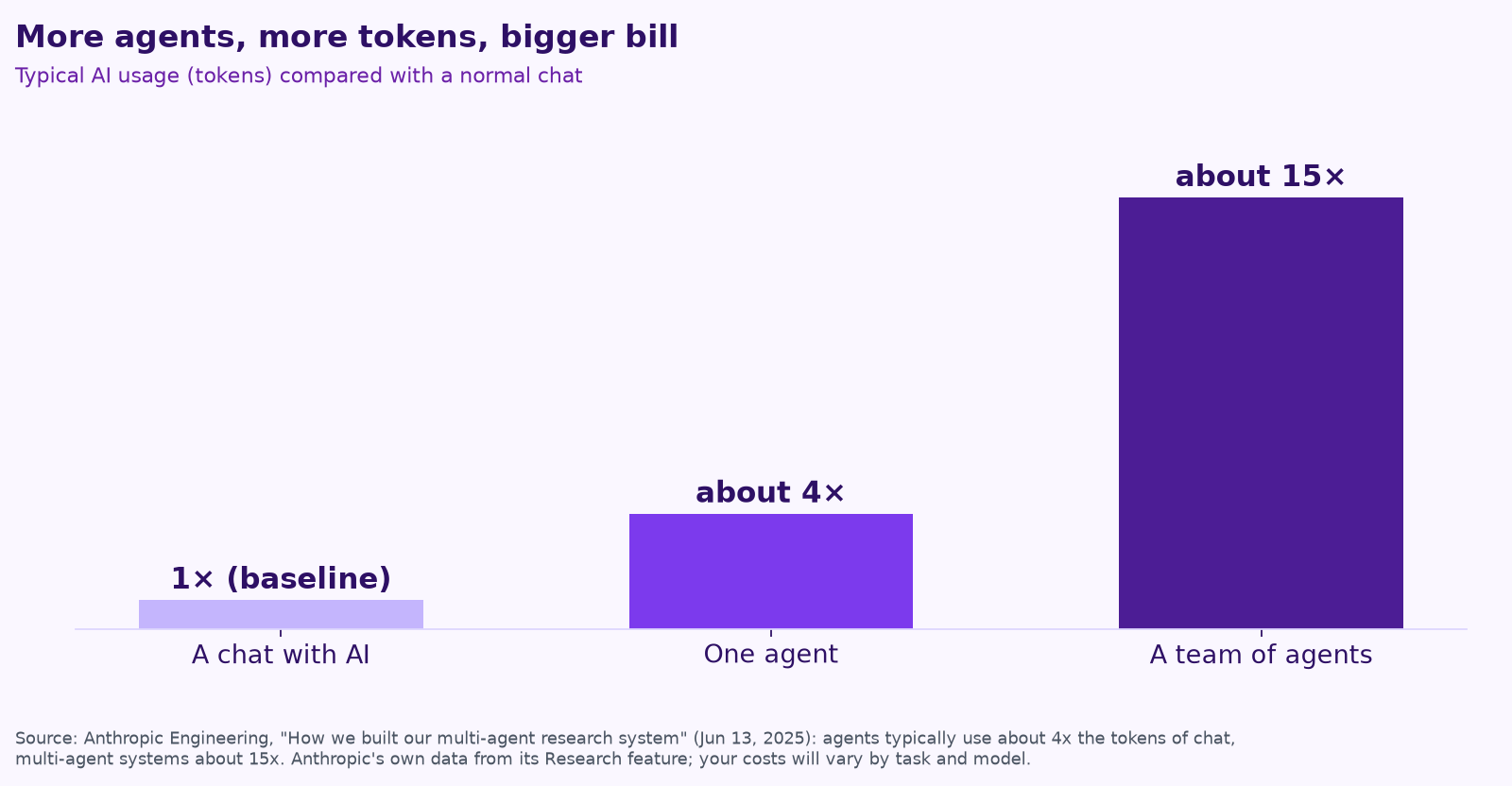
In Anthropic’s data, agents typically use about 4x the tokens of a normal chat, and multi-agent systems about 15x. Their conclusion: a team only makes economic sense when the task is valuable enough to pay for the extra performance. For a small business paying per use, that’s the whole question: is this job worth 15x the compute? Sometimes yes. Often, not yet.
So what is an “AI team” for a small business?
Here’s the reframe we find most useful. Think of a jobsite crew. You don’t send five people to hang one door, each handling a hinge and reporting to a foreman. You give one capable person the door, the right tools and the spec. Your crew is the set of people doing different jobs at the same time.
AI works the same way. A sensible AI team for a contractor might be three separate agents, each owning one job from start to finish. These are our illustrations, not client data:
| The job | Org-chart version (often worse) | One-job-one-agent version |
|---|---|---|
| Morning job report | A “field bot” reads logs, hands notes to a “schedule bot,” which hands a summary to a “writer bot.” | One agent reads the logs and the job tracker, checks against schedule and drafts the report. |
| Bid follow-up | An “estimating bot” and an “email bot” pass bid details back and forth. | One agent with read access to the estimating sheet and email history drafts follow-ups. |
| Weekly crew schedule | Separate bots for crews, weather and conflicts, plus a coordinator. | One agent with three thin tools: job list, crew calendar, forecast. |
Crew scheduling is a good example of the “chain of steps” problem from the Google study. Who goes where depends on which jobs start, which depends on weather, which changes the conflicts. Splitting that across bots is exactly where the research saw performance fall apart.
When a real team of agents does make sense
Anthropic lists three situations where separate subagents still earn their place. Here they are in plain terms:
- The single agent is visibly getting worse because it’s juggling too much information at once.
- The work truly runs in parallel and each piece can start fresh, like researching ten suppliers’ pricing at the same time.
- One agent keeps picking the wrong tool or has instructions that conflict with each other.
A simple example of the second case: comparing lead times on materials from several suppliers is a natural fit for helpers working side by side, then one agent pulling the answers together and checking them.
The hard part is knowledge, not headcount
LangChain CEO Harrison Chase put it simply late on November 18: “the hardest part of building agents is the context (or knowledge that they have).” That matches what the Anthropic article prescribes. Instead of building more agents, you write down how your business does things as skills the one agent can pull up when needed: how you word a change order, which jobs get priority, who signs off on what. Reference material like price lists and policies sits behind a lookup the agent can search.
For most owners, this is the real work: getting the know-how out of people’s heads and into something an agent can read. It’s not glamorous, and no tool does it for you. It’s also the part that pays off no matter which AI model you use next year.
The other hard part is trust. In a post AWS shared on X on November 18, Shawn Bice, who leads AWS’s Automated Reasoning Group, lays out four questions for any agent: what is it for and what must it never do, who authorized it, does it stay within its limits, and can you reconstruct what it did afterward. His advice fits a small business perfectly: “Start with one agent, one workflow, and one boundary you can prove. Then expand as the trust is earned.”
Before you add a second agent, check these:
- ☐ Is this one job, or truly several jobs that don’t depend on each other?
- ☐ Have I written down the steps and judgment calls as a short procedure the agent can follow?
- ☐ Does the agent have only the few tools it needs? Anthropic notes tool choice tends to degrade past 30-50 tool definitions, and most small-business jobs need four or five.
- ☐ Is there a clear “never do this” list and a person who approves anything that matters?
- ☐ Do I have 10 real examples of a good result to test against? Anthropic says even 10 “golden examples” is enough to start.
- ☐ Have I run each test more than once? In Anthropic’s own testing, one break only showed up in one run out of two.
- ☐ Is the job valuable enough to justify the extra cost of a team?
Where this is heading
None of this means agent teams are going away. Box CEO Aaron Levie wrote on November 18 that agents can now “fan out and work in parallel” and handle long-running work, and that we’ll soon hand agents goals rather than step-by-step tasks. Anthropic’s own advice is to keep checking as models improve: build a small test set, fold in one helper agent at a time, and keep it separate only if the combined version scores worse.
The takeaway for a small business is to start simple and earn your way up. One agent, one job, good written procedures, a few tools, and a person who signs off. Add helpers only when you can point to the reason.
How we think about it at Purple AI
This is how we build at Purple AI. We put AI agent teams to work for construction and trades businesses, and each agent on the team owns one job, like a morning job report, bid follow-ups or next week’s crew schedule. They run inside the tools you already use, and a person approves anything that matters. If you’d like to talk through which job in your business could go first, you can book a free 15-minute mini-audit at gopurple.ai.
Sources
- Anthropic, Building agents: When to fold subagents into your main agent loop (Claude resources).
- Ethan Mollick (@emollick), post on X about the Anthropic article (Nov 17, 2026).
- Yubin Kim et al., Towards a Science of Scaling Agent Systems, arXiv:2512.08296, and Google Research, Towards a science of scaling agent systems: When and why agent systems work.
- Anthropic Engineering, How we built our multi-agent research system (Jun 13, 2025).
- Harrison Chase (@hwchase17), post on X about context and knowledge (Nov 18, 2026, late evening Central time).
- Shawn Bice, AWS, Trust in Depth: Giving agents more autonomy without losing control (Oct 15, 2026), shared by @awscloud on X (Nov 18, 2026).
- Aaron Levie (@levie), post on X about the next era of agents (Nov 18, 2026).
Related on our blog: Give your AI agent a job, not a to-do list, AI for construction companies: 7 workflows to hand to AI agents, AI for trades businesses, What does fractional AI cost?, How to run an AI assessment in one week, AI agents vs. chatbots vs. automation, AI for property management, How to keep a human in charge of AI agents, Procore, ServiceTitan, Jobber and Buildertrend have AI now: where an agent team fits, Missed calls cost trades businesses jobs, AI for accounting and bookkeeping firms, AI receptionists for contractors: Jobber vs. ServiceTitan vs. standalone tools, A free AI use policy template for small businesses, AI for construction estimating and takeoffs, How to measure AI agent ROI with the hours-back method, AI for HVAC maintenance agreements and renewals, AI for construction safety documentation and toolbox talks, AI for lien waivers and pay applications and AI for roofing storm-season leads and claim reports.
Free checklist
Find 10 hours a week: the AI checklist for contractors
30 places construction and trades businesses lose time every week, and what an AI agent can take off your plate. On the page or as a printable PDF.
Get the checklist →