

On November 4, Google made it possible to research and book a plumber, HVAC tech or other home service pro directly from AI Mode in Search. Robby Stein, a vice president of product for Google Search, announced it on X with partners including Angi, Thumbtack, Housecall Pro and Jobber, with ServiceTitan “coming soon.” His own example was a backed-up main line at home: he described the problem, and AI Mode “compared local pricing, checked reviews, and made recommendations” before he booked a plumber.
That’s where the trades are heading: customers who find, compare and book faster than ever, and expect an answer right away. The good news for a small HVAC, plumbing, electrical or roofing shop is that the same kind of AI can work on your side of the phone. Here’s where AI agents save the most hours, what to keep human, and how to start without spending a fortune.
Running a trades business? Our AI for trades businesses page lays out the workflows we build (HVAC, plumbing, electrical and roofing workflows, from lead replies to invoices), how it works and plans.
1. Answering the phone (and texting back the ones you miss)
Calls are still the front door. Invoca analyzed calls to home services businesses across HVAC, plumbing, construction, restoration and other trades and found that only 52% of inbound calls reach a person. Filter out misdials and quick hang-ups by looking only at calls longer than 15 seconds, and it’s 65% (Invoca, Home Services Lead Conversion Benchmarks Report 2026). Answer rates ranged from 32% to 74% depending on the trade.
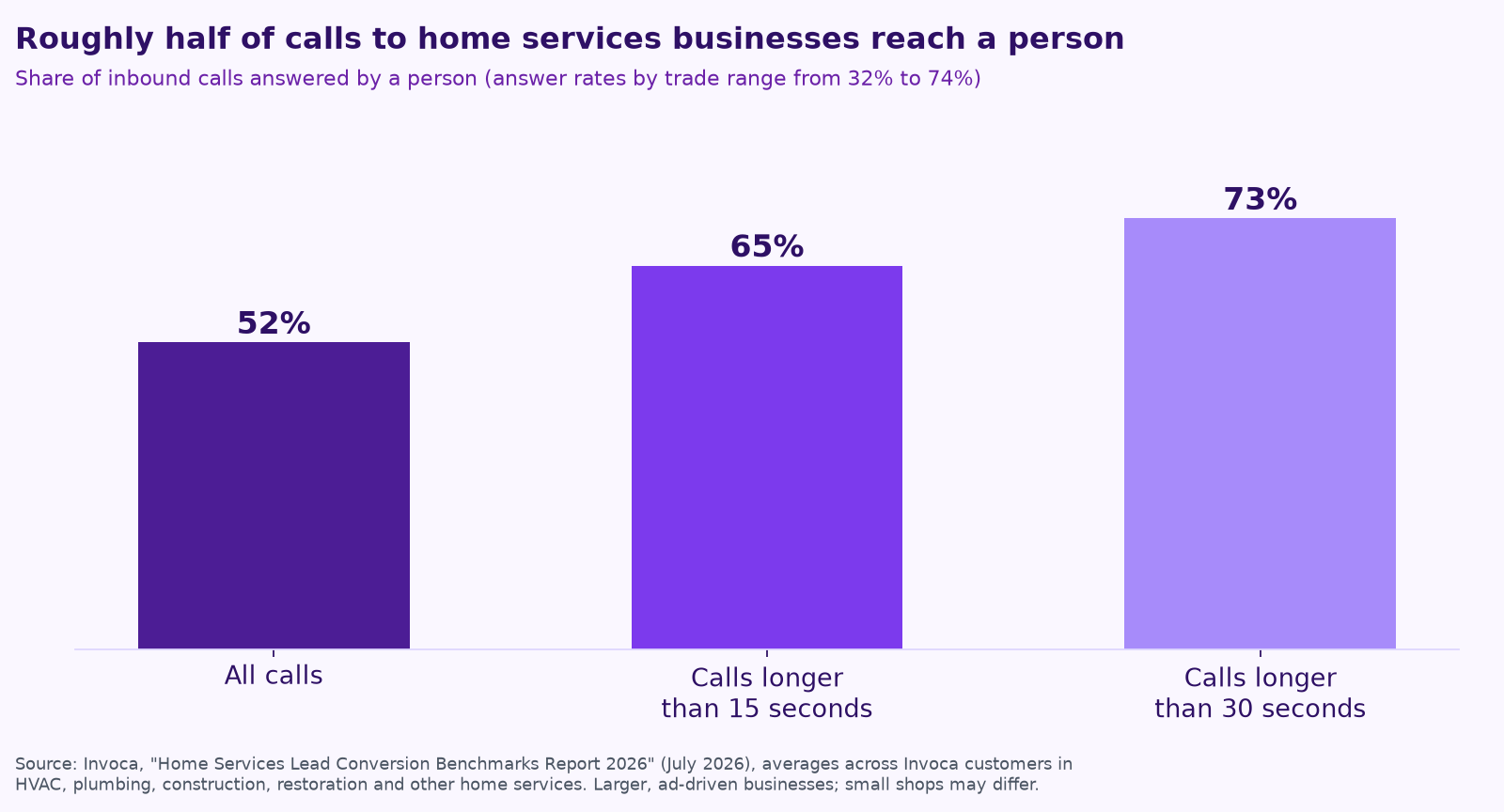
Those numbers come from Invoca’s customers, which skew toward larger businesses running ads, so a three-truck shop may look different. But anyone who has been on a roof when the phone rang knows the problem.
What an agent does: answers overflow and after-hours calls, collects the address, the problem and how urgent it is, books into open slots using your rules, texts back missed callers within a minute, and sends the on-call tech a summary for real emergencies.
What stays with you: pricing promises, emergency judgment calls and anything the agent isn’t sure about. And keep agents to answering and replying. Since a February 2024 FCC ruling, AI-generated voices count as “artificial” voices under federal robocall law, so outbound AI calls generally need the person’s prior consent.
2. Dispatch and scheduling
AI dispatch is one of the most promising and most misunderstood uses. ServiceTitan shared on X that AI dispatch “fell short” at HomeX Services Group until the team standardized technician skills and job types. Then came a “huge leap,” according to CTO Jennifer D’Ambra.
That’s the lesson for any shop: the agent can only be as good as the setup it reads. If your job types are a mess and nobody has written down which techs can handle commercial rooftop units, no software will schedule well.
What an agent does: proposes tomorrow’s board based on skills, location and job length, flags conflicts, reshuffles when a job runs long, and sends customers “on the way” and rescheduling texts.
What stays with you: the final board, especially for your best customers and your newest techs.
3. Quotes and follow-ups
Invoca’s report found that 55% of home services businesses don’t ask leads to buy or book the job on the call. Quotes have the same problem after the visit: the estimate goes out and nobody follows up.
What an agent does: turns the tech’s notes and photos into a clean quote from your price book with good-better-best options, then follows up on unsold estimates on a schedule you set (two days, a week, before the season changes), and tells you which ones replied.
What stays with you: the price and any discount. The agent drafts; your comfort advisor or owner approves.
4. Reviews
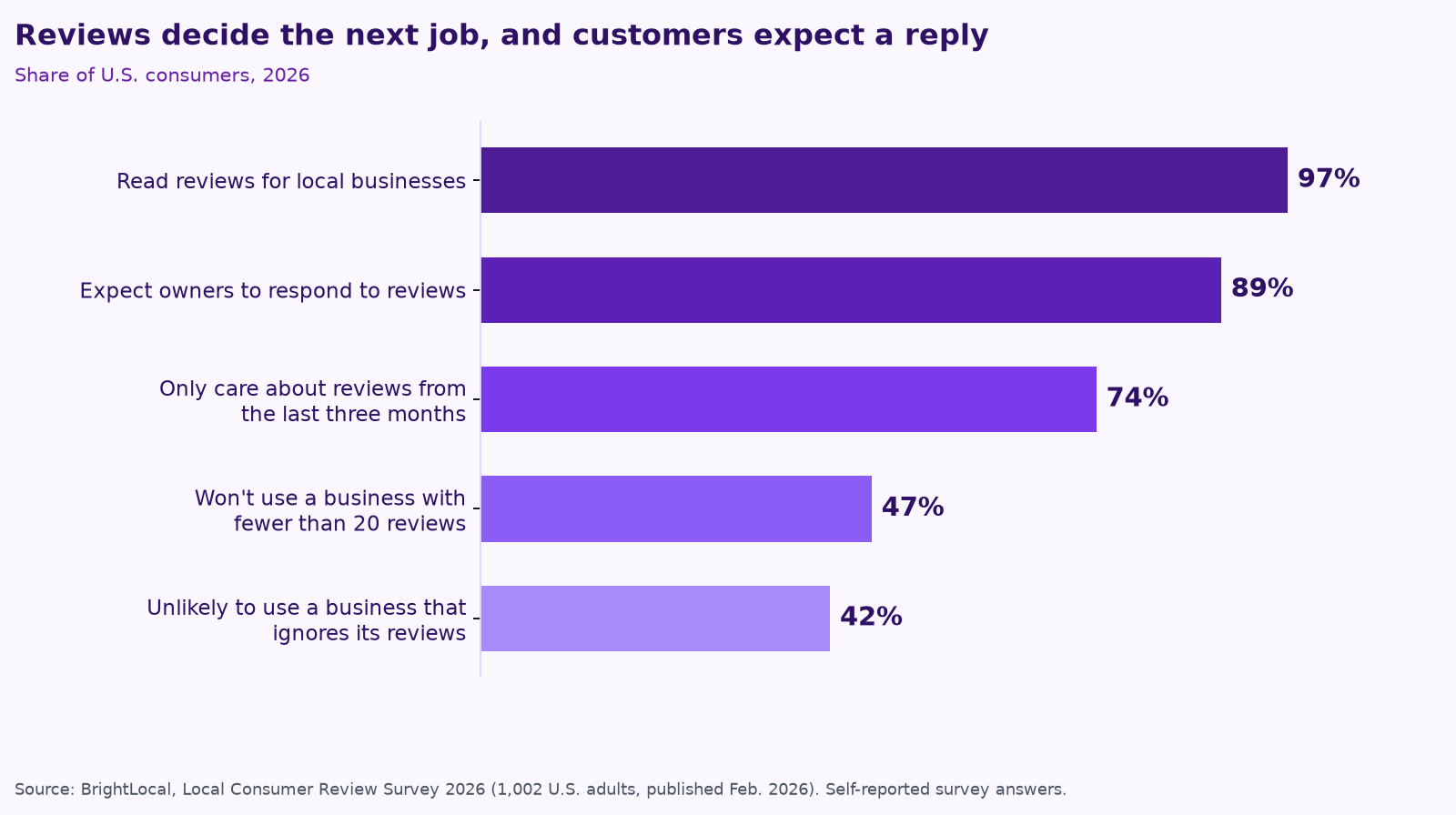
Reviews decide who gets the next call. In BrightLocal’s 2026 survey of 1,002 U.S. adults, 97% of consumers read reviews for local businesses, 74% care only about reviews from the last three months, 47% won’t use a business with fewer than 20 reviews, and 89% expect owners to respond (BrightLocal, Local Consumer Review Survey 2026). Recent reviews matter even more now that AI assistants like Google’s AI Mode check them for customers.
What an agent does: sends a review request by text when a job is marked complete, reminds once, drafts a personal reply to every new review, and alerts you right away to anything under four stars.
What stays with you: replies to unhappy customers, and never offering anything in exchange for a review.
5. The back office: invoices, memberships and parts
Smaller jobs that add up: chasing unpaid invoices, renewing maintenance memberships before they lapse, reminding customers about seasonal tune-ups, and keeping a running list of parts to reorder from the techs’ notes. Each one is a repeatable pattern an agent can draft and track while your office manager approves.
Vendor stories vs. your results
Software companies are racing into this space, and their stories are encouraging. ServiceTitan, for example, says its customer Comfort Now used two AI virtual agents to handle a summer call spike, freeing the owner to close a large commercial replacement job. Treat stories like that as what’s possible, not a forecast. Your results depend on your call volume, your setup and how well the work is written down. That’s why we recommend measuring your own baseline first; see how to run an AI assessment in one week.
Where to start
A two-week starting plan for a trades shop
- ☐ Pull last month’s call log. How many calls were missed, and when?
- ☐ Count open estimates with no follow-up in the last seven days.
- ☐ Check your Google reviews: how many came in over the last three months, and how many have a reply?
- ☐ Write down your job types and which techs can do each one.
- ☐ Pick the biggest gap and give one agent that one job, with a person approving anything that commits you.
For most shops the first job is missed calls or estimate follow-up, because the payoff shows up in booked jobs within weeks. Start with one agent and one job; we explain why in Your AI team shouldn’t copy your org chart.
By trade: see how agent teams work for HVAC companies, plumbers, electrical contractors, roofing companies and remodelers.
Keep reading
- AI for construction companies: 7 workflows a small contractor can hand to AI agents
- What does fractional AI cost? Hiring vs. a fractional AI partner vs. DIY
- Give your AI agent a job, not a to-do list
- AI agents vs. chatbots vs. automation: what a small business actually needs
- AI for property management: maintenance requests, leasing follow-up and owner reports
- How to keep a human in charge of AI agents
- Procore, ServiceTitan, Jobber and Buildertrend have AI now. Where does an agent team fit?
- Missed calls cost trades businesses jobs: AI answering, intake and follow-up done right
- AI for accounting and bookkeeping firms: close, client follow-up and document chase
- AI receptionists for contractors: Jobber vs. ServiceTitan vs. standalone tools
- A free AI use policy template for small businesses
- AI for construction estimating and takeoffs
- How to measure AI agent ROI with the hours-back method
- AI for HVAC maintenance agreements and renewals
- AI for construction safety documentation and toolbox talks
- AI for lien waivers and pay applications
- AI for roofing storm-season leads and claim reports
How we do this at Purple AI
Purple AI is an AI consulting firm for small businesses, and we start with construction and trades. We set up a small team of AI agents inside the tools you already use, give each agent one job, and keep a person in charge of anything that matters. Then we stay on to tune it as your business and the AI tools change.
The easiest first step is a free 15-minute AI mini-audit. We’ll look at where your week goes and name the one or two jobs we’d hand to an agent first. Book your mini-audit here.
See how this works for your business on our AI for trades businesses page, or grab the free AI checklist for contractors.
If it’s a fit, ongoing plans are Starter at $750 a month (one workflow or dashboard), Core at $1,000 a month (an ongoing agent team, our most popular plan) and Growth at $1,250 a month (agents across several departments). If you want a deeper look first, there’s an optional $2,500 assessment, and $1,000 of it is credited to your first month.
Sources
- Robby Stein (@rmstein), post on X announcing home services booking in Google AI Mode (Nov 4, 2026), and ServiceTitan’s reply.
- Invoca, The Invoca Home Services Lead Conversion Benchmarks Report 2026 (July 2026).
- Federal Communications Commission, FCC Confirms that TCPA Applies to AI Technologies that Generate Human Voices (Feb 8, 2024).
- ServiceTitan (@ServiceTitan), post on X about AI dispatch at HomeX Services Group (Nov 3, 2026).
- BrightLocal, Local Consumer Review Survey 2026 (1,002 U.S. adults).
- ServiceTitan (@ServiceTitan), post on X about Comfort Now’s AI virtual agents (Nov 12, 2026).
Free checklist
Find 10 hours a week: the AI checklist for contractors
30 places construction and trades businesses lose time every week, and what an AI agent can take off your plate. On the page or as a printable PDF.
Get the checklist →