

Storm week does not just bring more leads. It brings a pile of photos, insurer questions and follow-ups that a tired office will drop. An AI agent can help a roofing shop catch the surge, keep a clean list, and turn a phone full of jobsite pictures into a factual report a person can stand behind. It should not invent damage, alter photos, or send anything to an insurance company on its own.
The work arrives in bursts
Hail and wind remain the main drivers of insured roof losses. In 2025, State Farm paid out more than $5.6 billion in hail-related claims, with Texas first at $1.4 billion, followed by Missouri, Illinois, Wisconsin and Oklahoma. In a release dated April 21, 2026, the company said March storms had already triggered more than 50,000 claims in the Midwest, and that the National Weather Service reported more than 650 hail events on March 10 across nine states (State Farm).
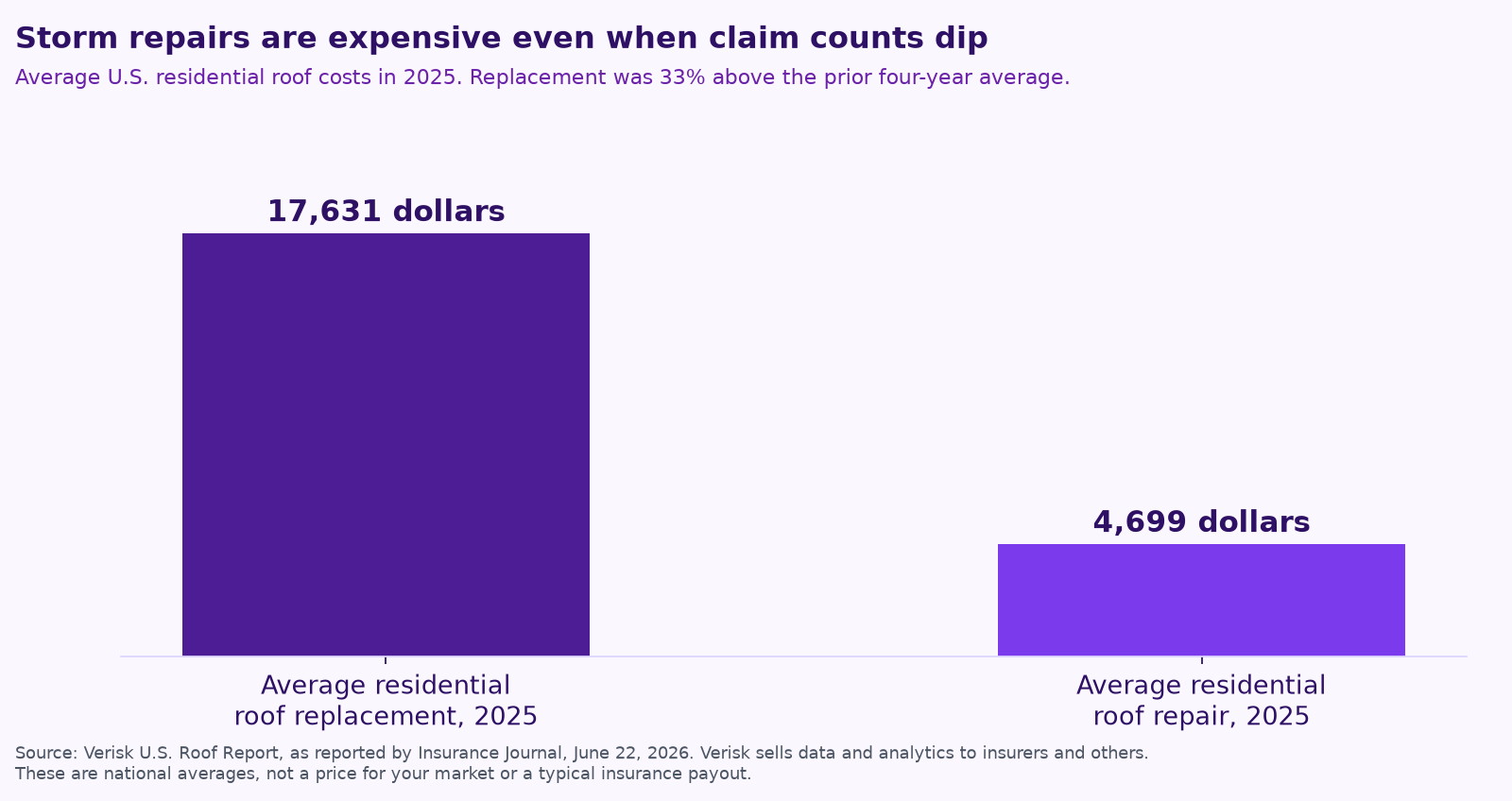
Verisk’s U.S. Roof Report, as covered by Insurance Journal in June 2026, found that 16 states had severe hail (one inch or larger) impact more than 20% of roofs in 2025, up from 12 states in 2024. Average U.S. residential roof replacement cost reached $17,631 in 2025, with repairs averaging $4,699, and replacement costs were 33% higher than the prior four-year average. Total roof replacement cost value was $23 billion, a bit below the 2021-2024 average, largely because the 2025 U.S. hurricane season was quiet. Roofing line items still made up about 30% of line items in property-claim estimates (Insurance Journal, reporting Verisk). Verisk sells data and analytics to insurers and others. The useful takeaway for a shop is not a national forecast. It is that storm work is bursty, expensive, and uneven by metro, which is exactly when intake and documentation fall behind.
Where an agent fits in storm week
Use the answering and booking tools you already pay for first. If calls are already spilling over, fix that before you add anything new: see missed calls cost trades businesses jobs and our comparison of AI receptionists. The storm-specific job is what happens after the phone is answered.
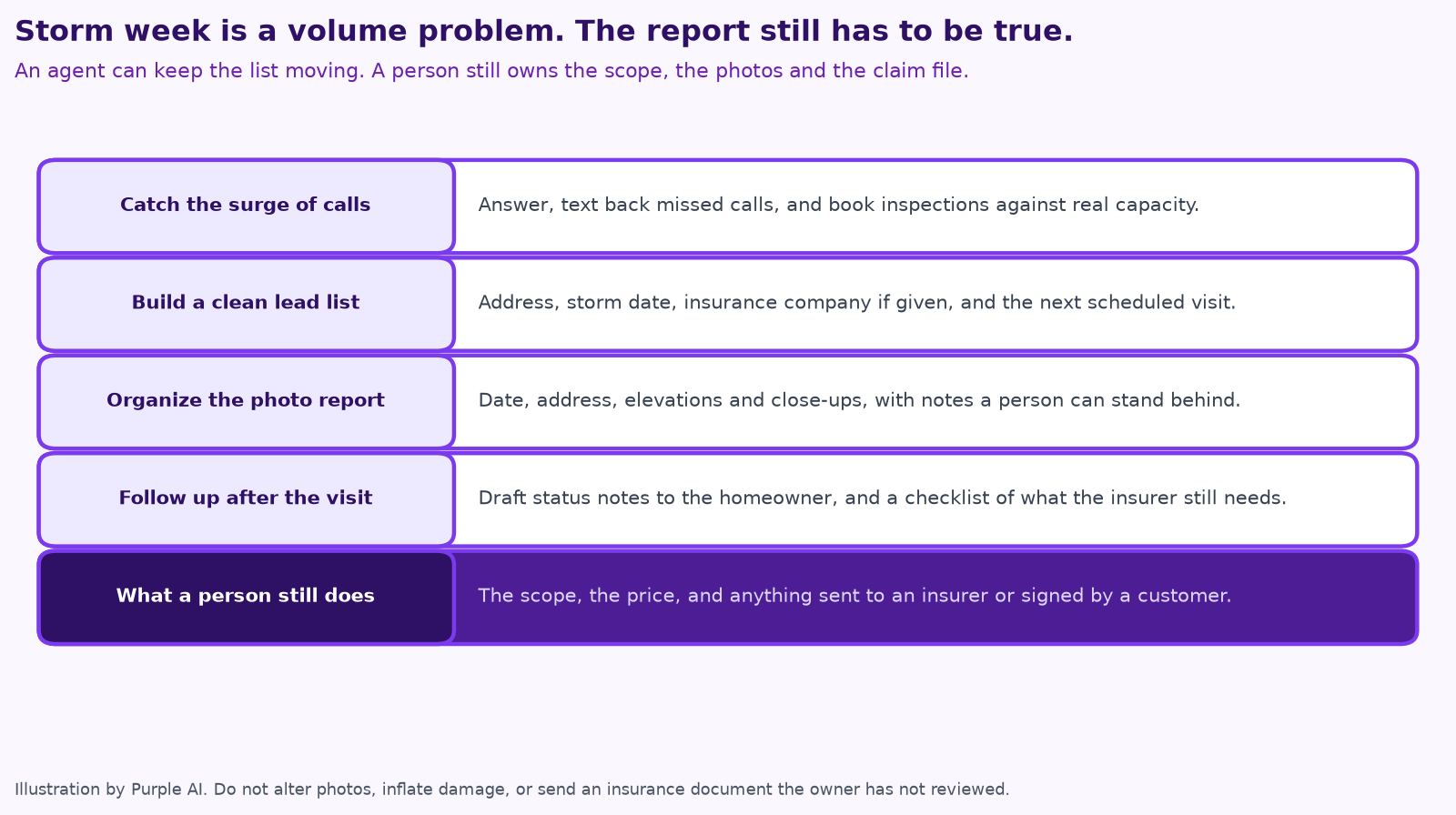
- Catch and log the surge. Every new call or web form becomes a record with an address, the storm date, the insurer if the customer gave it, and the next visit on the calendar. The agent should book only against capacity you have set.
- Keep a clean lead list. Who has an inspection scheduled, who is waiting on photos, who is waiting on the insurer, and who has gone quiet.
- Organize the photo report. Date, address, weather at the time of the visit if you record it, elevations, close-ups, and a short caption for each set. The report should describe what the photos show, not what would be convenient for a claim.
- Draft follow-up to the homeowner: what you found, what happens next, and what the insurer still needs, for a person to send.
The report has to be true
After hail, homeowners are already being warned about bad contractors. State Farm’s own hail release tells customers to verify a contractor’s license and reputation, and to consult their insurer before signing a repair contract (State Farm). That is the standard a legitimate shop should meet, and it is the line an agent must not cross.
- Do not alter photos, crop out context, or add damage that is not in the image.
- Do not draft language that coaches a customer to overstate a claim.
- Do not send a report, estimate or authorization to an insurer until a person has reviewed it.
- If your people are knocking doors after a storm, they should identify the company, avoid pressure, and leave when asked.
A factual photo report is still valuable. Adjusters and office staff waste hours hunting through unlabeled images. An organized packet (address, date, elevations, close-ups, notes) speeds a honest claim and protects you if someone later disputes what was visible on the day you were there. The owner of that packet is the estimator or project manager, not the model that sorted the files. See how to keep a human in charge and our AI use policy template, which already says not to pass off AI images as photos of real jobs.
A simple storm-week scoreboard
Pick a few numbers you can review every morning while the surge lasts:
- New leads, calls answered, and calls missed yesterday.
- Inspections scheduled versus remaining capacity this week.
- Photo reports completed and waiting for review.
- Follow-ups sitting more than two days without a next step.
If you want to measure the office time this gives back after the storm, use the hours-back method on intake and report prep, not on revenue you cannot clearly attribute to the agent.
Storm-season checklist
- ☐ Overflow answering and booking rules are in place before the next severe weather.
- ☐ Every lead has an address, a storm date and a next step.
- ☐ Photo reports are organized by date and elevation, with no edited or unlabeled images.
- ☐ A person reviews anything that goes to a homeowner or an insurer.
- ☐ We do not coach claims or alter photos.
- ☐ Safety talks for roof work still get delivered and signed; see toolbox talks and safety documentation.
This is a roofing-first workflow, but the same surge pattern shows up whenever weather fills the board. Start with AI for roofers, then AI for trades, HVAC, plumbers, electricians, remodelers, construction and the contractor AI checklist.
Keep reading
- AI for roofers
- Missed calls cost trades businesses jobs
- AI receptionists for contractors, compared fairly
- AI for construction safety documentation and toolbox talks
- AI for lien waivers and pay applications
- How to keep a human in charge of AI agents
- AI for dispatch and quotes: where trades shops save hours
- How to measure AI agent ROI with the hours-back method
- A free AI use policy template for small businesses
- How to run an AI assessment for your small business in one week
How we do this at Purple AI
Purple AI is an AI consulting firm for small businesses, and we start with construction and trades. We set up a small team of AI agents inside the tools you already use, give each agent one job, and keep a person in charge of anything that matters. Then we stay on to tune it as your business and the AI tools change.
The easiest first step is a free 15-minute AI mini-audit. We’ll look at where your week goes and name the one or two jobs we’d hand to an agent first. Book your mini-audit here.
If it’s a fit, ongoing plans are Starter at $750 a month (one workflow or dashboard), Core at $1,000 a month (an ongoing agent team, our most popular plan) and Growth at $1,250 a month (agents across several departments). If you want a deeper look first, there’s an optional $2,500 assessment, and $1,000 of it is credited to your first month.
Sources
- State Farm, State Farm Paid Over $5.6 Billion in Hail Claims in 2025 (April 21, 2026), including National Weather Service hail-event counts cited in that release.
- Insurance Journal, Roof Costs Soar Even as Claims Decline: Verisk (June 22, 2026), reporting Verisk’s U.S. Roof Report. Verisk sells data and analytics to insurers and others.
Free checklist
Find 10 hours a week: the AI checklist for contractors
30 places construction and trades businesses lose time every week, and what an AI agent can take off your plate. On the page or as a printable PDF.
Get the checklist →