

Property management is full of work that repeats every day: maintenance requests, leasing questions, renewals, vendor coordination and the monthly owner report. That makes it one of the best fits for AI agents, and the industry has noticed. Buildium’s 2026 industry report found that the share of property management companies using AI jumped from 20% in 2024 to 58% in 2025. But only 8% had fully automated any workflow; most were using AI to write property descriptions and emails (Buildium, 2026 Property Management Industry Trends).
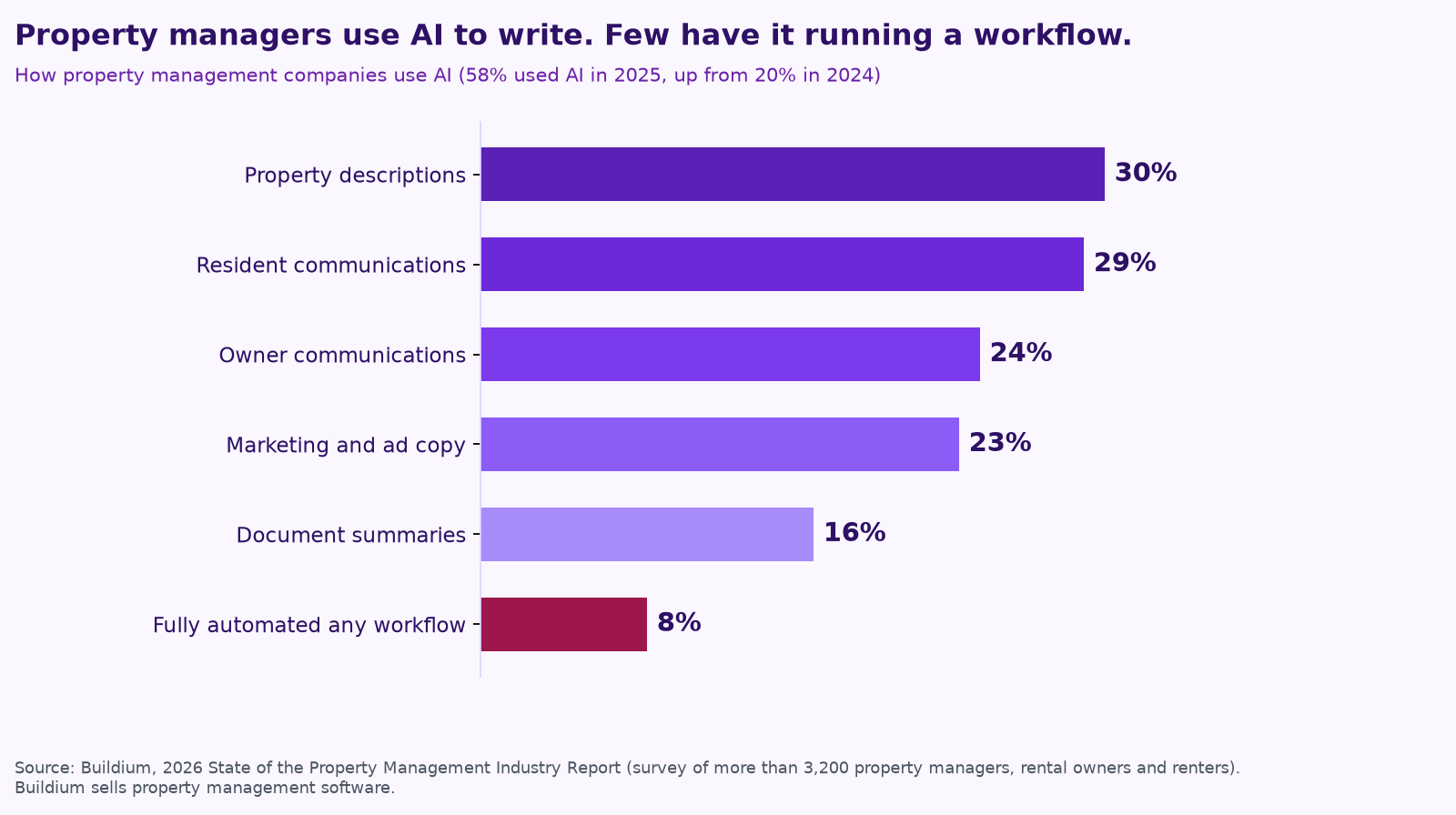
The gap between “AI writes my emails” and “AI handles the maintenance queue while I approve the important parts” is where the hours are. Here’s what that looks like for a small or mid-sized property management company, residential or commercial, and what should stay with your people.
1. Maintenance requests: intake, triage and updates
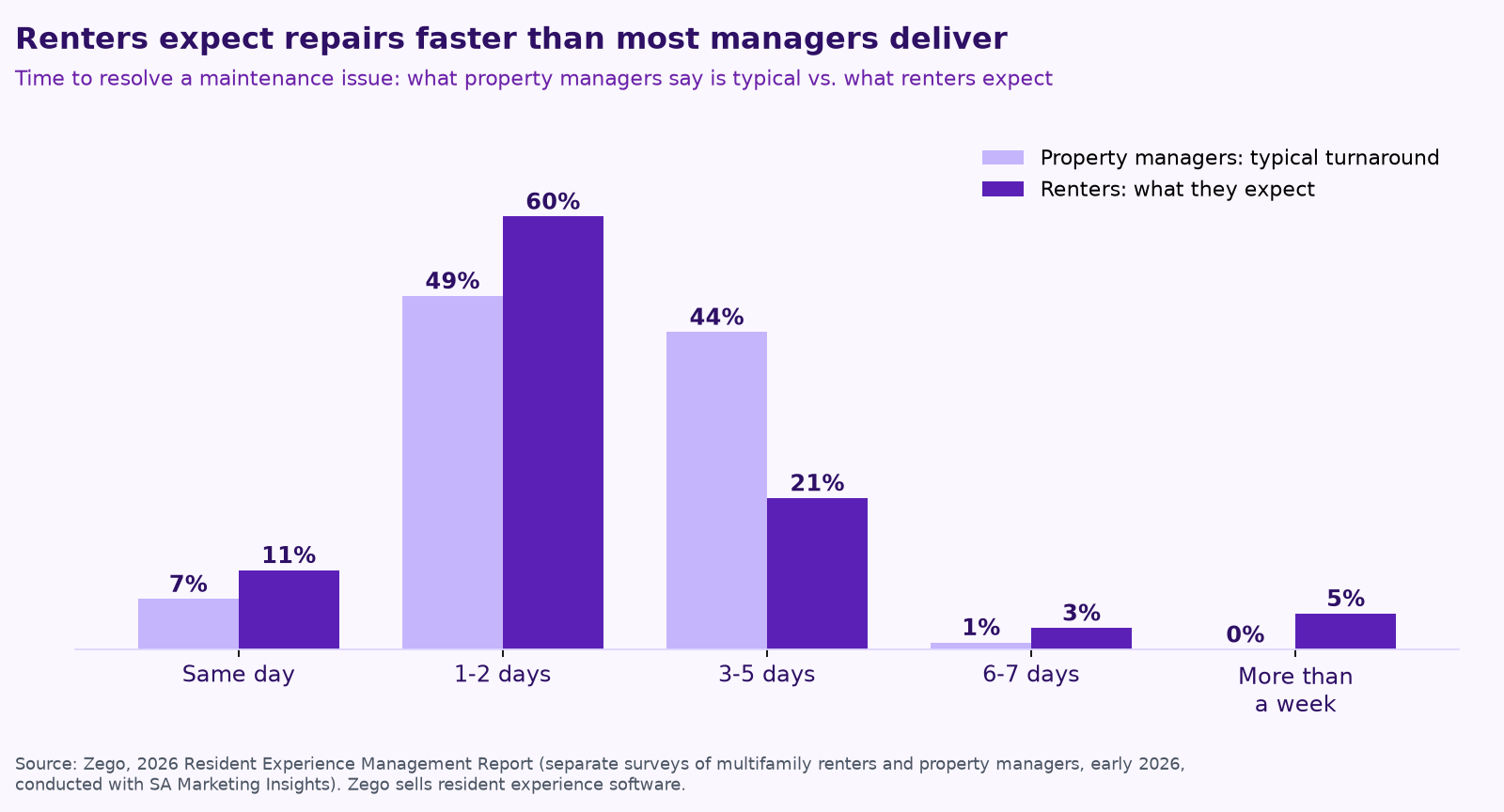
Maintenance is the part of the job residents care about most. In AppFolio’s 2026 survey of 3,002 U.S. renters, maintenance was the strongest single driver of renter satisfaction, and renters satisfied with maintenance were 81% more likely to renew (AppFolio, 2026 Renter Preferences Report). Expectations are high. In Zego’s 2026 surveys, 60% of renters expected a repair to be resolved in one to two days, while 44% of property managers said three to five days was typical, and 89% of renters rated status updates as important (Zego, 2026 Resident Experience Management Report).
What an agent does: takes requests by text, email or portal at any hour; asks for photos, the unit and access instructions; sorts emergencies from routine work; walks residents through simple fixes like a tripped breaker; creates the work order; assigns your preferred vendor by trade and property; and sends residents status updates without anyone having to remember to.
What stays with you: emergencies go straight to your on-call person by phone, which is also what residents want. AppFolio found two-thirds of renters prefer a phone call in an emergency. Approvals above a dollar limit, anything involving owner money and any judgment about lease responsibility stay human.
2. Leasing follow-up
What an agent does: answers common questions about pets, parking, utilities, move-in costs and availability in seconds using your actual listing details; offers showing times from your calendar; follows up after showings; nudges applicants with incomplete applications; and starts renewal conversations on your schedule, such as 90 and 60 days out.
What stays with you: screening and approval decisions, pricing, concessions and anything that touches fair housing rules. An agent should give every prospect the same accurate information; people make the decisions.
3. Owner reports
Monthly owner statements come out of your accounting system, but owners want to know what happened: why expenses went up, which work orders closed, how leasing is going. Writing that summary for every owner is a classic end-of-month crunch.
What an agent does: pulls the month’s income, expenses, work orders and vacancy data for each property and drafts a short, plain-English summary for each owner, flagging anything unusual, like a repair that ran over budget or a unit vacant longer than normal.
What stays with you: the manager reads and approves each report before it goes out, and the numbers always come from the accounting system rather than the AI’s memory.
4. The rest of the inbox
- Vendor coordination: confirm appointments, chase invoices and certificates of insurance, and log completion photos.
- Rent reminders and notices: friendly reminders on your schedule. Legal notices are always prepared and sent by a person.
- Reviews and reputation: AppFolio found 90% of renters say a company’s online reputation factors into where they lease. An agent can ask happy residents for reviews after a closed work order and draft replies for your approval.
The integration question
Most small and mid-sized managers run on a property management system such as AppFolio, Buildium, Rent Manager or Yardi. An agent is only as useful as its access to that data. Peter Lohmann, sharing a 30-minute property management discussion with Mark Brower on X in October, pointed to “a palpable shift in how property managers talk about AI implementation” at the NARPM national conference this year, and to why “understanding data access matters more than ever for business owners” (Peter Lohmann on X).
Practically, that means checking three things before you start: what your software lets you export or connect to, which inbox or phone line residents actually use, and where your policies live (pet rules, vendor list, approval limits). If the answers are scattered, writing them down is step one. Our one-week AI assessment guide walks through it.
Where to start
- ☐ Pull last month’s work orders: how long did it take to acknowledge and to close each one?
- ☐ Count leasing inquiries that waited more than a few hours for a reply.
- ☐ Time how long the owner reports took at month-end.
- ☐ Write down your emergency rules, approval limits and preferred vendors.
- ☐ Pick one: maintenance intake and updates are usually the fastest win, and owner reports the easiest to check.
Whichever you pick, keep a person in charge of anything that commits money, a lease decision or a legal notice. We explain how to set that up in How to keep a human in charge of AI agents, and why plain automation often beats an agent for routine steps in AI agents vs. chatbots vs. automation.
Keep reading
- AI agents vs. chatbots vs. automation: what a small business actually needs
- How to keep a human in charge of AI agents
- AI for trades businesses: dispatch, quotes, follow-ups and reviews
- AI for construction companies: 7 workflows to hand to AI agents
- What does fractional AI cost?
- How to run an AI assessment in one week
- Give your AI agent a job, not a to-do list
- Your AI team shouldn’t copy your org chart
- Procore, ServiceTitan, Jobber and Buildertrend have AI now. Where does an agent team fit?
- Missed calls cost trades businesses jobs: AI answering, intake and follow-up done right
- AI for accounting and bookkeeping firms: close, client follow-up and document chase
- AI receptionists for contractors: Jobber vs. ServiceTitan vs. standalone tools
- A free AI use policy template for small businesses
- AI for construction estimating and takeoffs
- How to measure AI agent ROI with the hours-back method
- AI for HVAC maintenance agreements and renewals
- AI for construction safety documentation and toolbox talks
- AI for lien waivers and pay applications
- AI for roofing storm-season leads and claim reports
How we do this at Purple AI
Purple AI is an AI consulting firm for small businesses, and we start with construction and trades. We set up a small team of AI agents inside the tools you already use, give each agent one job, and keep a person in charge of anything that matters. Then we stay on to tune it as your business and the AI tools change.
The easiest first step is a free 15-minute AI mini-audit. We’ll look at where your week goes and name the one or two jobs we’d hand to an agent first. Book your mini-audit here.
If it’s a fit, ongoing plans are Starter at $750 a month (one workflow or dashboard), Core at $1,000 a month (an ongoing agent team, our most popular plan) and Growth at $1,250 a month (agents across several departments). If you want a deeper look first, there’s an optional $2,500 assessment, and $1,000 of it is credited to your first month.
Sources
- Buildium, 2026 Property Management Industry Trends and 2026 Property Management Industry Report.
- AppFolio, What 3,002 Renters Say Matters When Free Rent Offers End (2026 Renter Preferences Report, survey conducted Jan. 26 to Feb. 4, 2026).
- Zego, 2026 Resident Experience Management Report (surveys of multifamily renters and property managers, early 2026).
- Peter Lohmann (@pslohmann), post on X about his property management discussion with Mark Brower (Oct 20, 2026).
Free checklist
Find 10 hours a week: the AI checklist for contractors
30 places construction and trades businesses lose time every week, and what an AI agent can take off your plate. On the page or as a printable PDF.
Get the checklist →