

A single price makes the homeowner guess. Three real options let them choose. An AI agent can draft a good, better and best quote from the technician’s notes, photos and your price book, then follow up on the ones that did not close. It should not invent a scope, pick a price or close the job on its own. A person still stands in the kitchen or at the panel and owns the number.
Shops that present options close more often on the visit
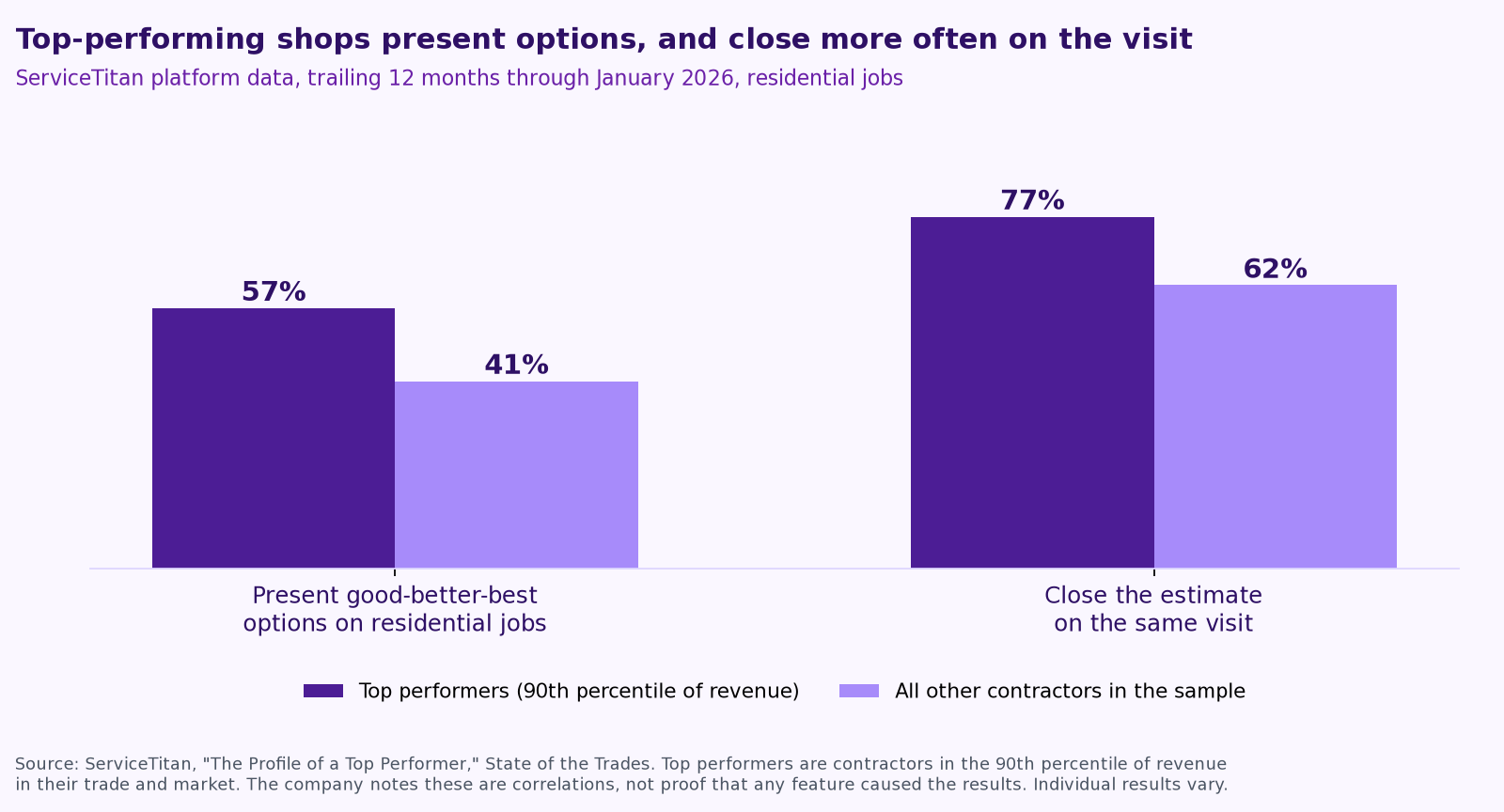
ServiceTitan looked at platform data for commercial and residential contractors across HVAC, plumbing, electrical and other specialty trades, and defined top performers as those in the 90th percentile of revenue in their trade and market. On 57% of residential jobs, those top performers presented good-better-best proposals. The rest of the sample did this on 41% of residential jobs. Top performers also closed 77% of their estimates during the same visit, compared with 62% for everyone else (ServiceTitan, trailing 12 months through January 2026).
The company sells the software that records these jobs, and it is clear about the limits of the data: the figures describe behaviors correlated with higher revenue, not proof that presenting options caused the results, and individual results vary. Certain metrics, including these two, apply to residential jobs only. The useful takeaway is not a target percentage. It is that presenting real choices is a habit you can train, and that a quote which sits overnight is easier to lose.
Good, better and best have to be real work
An option is not a higher number on the same line. Each step up should add something the customer can see or measure: a longer warranty, a safer repair, a part that will not fail next season, a unit that costs less to run. ServiceTitan’s own field playbook tells shops to present at least three options, and recommends four for electrical work, using proposal templates so technicians are not rebuilding the math in the driveway (ServiceTitan help center).
The structure is the same whether the call is a leaking water heater or a hot panel. This is only an illustration of how the tiers can differ, not a scope or a price for any job:
- Good is the sound repair that solves today’s problem and leaves the system safe, priced from your book.
- Better adds the work you would recommend if the customer wants fewer callbacks: the related part that is already worn, the upgrade that matches what is already in the house.
- Best is the longer-term fix, with the warranty, efficiency or capacity the condition actually calls for, including the permits a person still pulls.
If the only honest option is a repair, do not invent two upgrades so the page looks full. A person decides what is actually needed. This is a service-quote workflow, not a construction bid. For takeoffs and bid day, see AI for construction estimating and takeoffs.
Where an agent fits
Use the proposal tools in the field software you already pay for first. If ServiceTitan, Jobber or Housecall Pro already has estimate templates, build those before you add anything new. See where an agent team fits next to the AI already in those platforms. The agent’s job is to make the options consistent and to follow up on the ones that did not close.
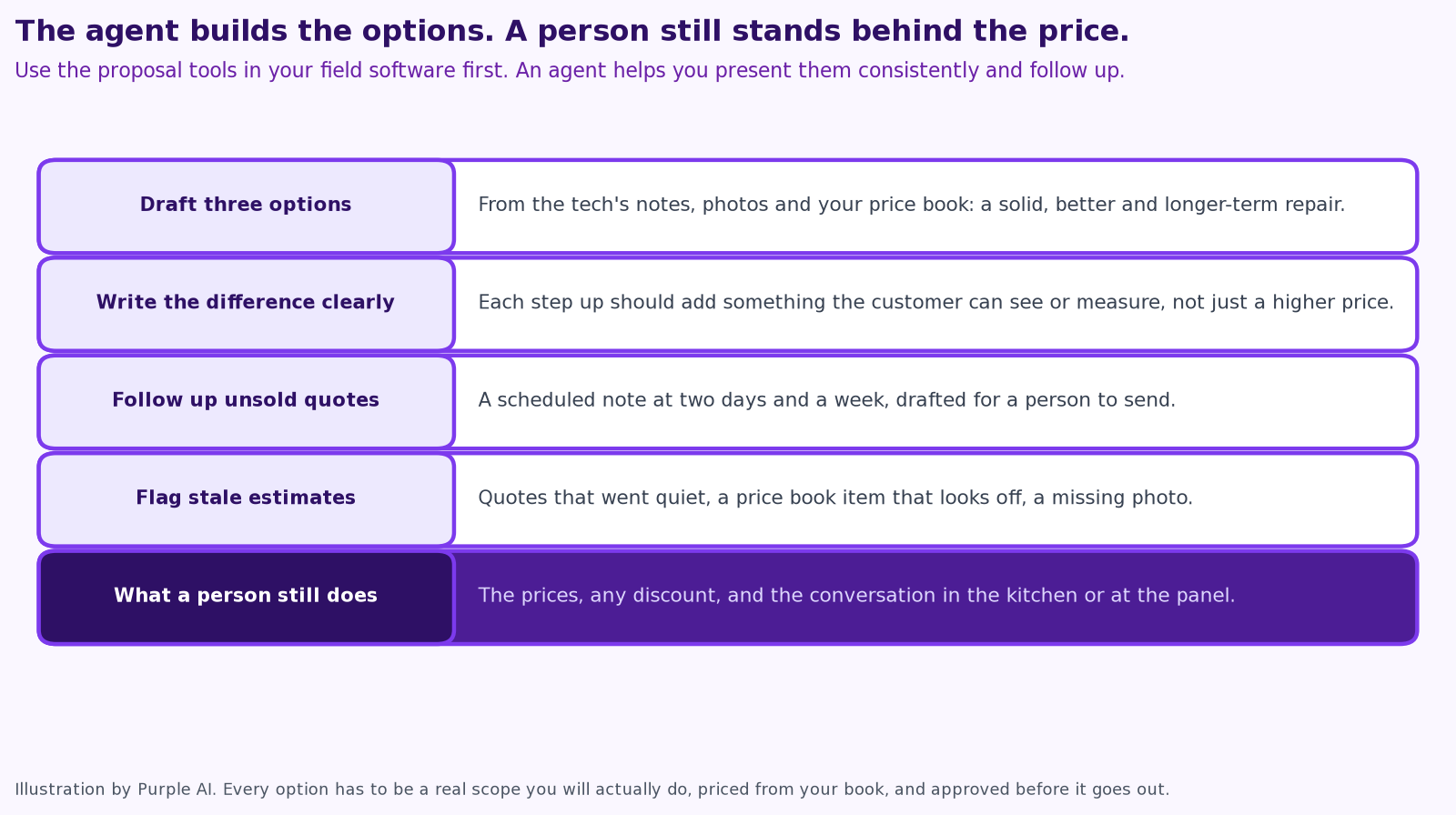
- Draft three options from the technician’s notes, photos and your price book: a solid repair, a better repair and a longer-term fix, each with a plain-English difference the customer can understand.
- Write the difference clearly. Each step up should name what is added, not just a larger total.
- Follow up unsold quotes with a scheduled note at two days and at a week, drafted for a person to send. Do not let the agent text or email a customer on its own.
- Flag stale estimates: quotes that went quiet, a price-book item that looks off, a missing photo or a “best” option that is only a higher number.
What a person still does
The technician or owner still decides the scope, the price, any discount and whether the work is safe to sell. They still have the conversation in the house. They still pull the permit. An agent should not close a job, apply a courtesy discount or present an option that is not in the price book. If a customer asks to finance the work, a person walks them through the terms you actually offer. See how to keep a human in charge and our AI use policy template.
A short weekly scoreboard
Pick a few numbers you can review on Friday:
- Share of residential jobs that went out with at least three real options, not a single price.
- Estimates closed on the visit versus estimates still open after two days and after a week.
- Follow-ups drafted and waiting for a person to send.
- Quotes flagged because a photo, a price or a scope was missing.
If you want to measure the office time this gives back, use the hours-back method on quote prep and follow-up, not on ticket size you cannot clearly attribute to the agent. ServiceTitan’s own write-up is a correlation, not a promise that options will raise your average ticket.
Good-better-best checklist
- ☐ Proposal templates in your field software are built from your price book, with at least three options on the jobs that deserve them.
- ☐ Each step up adds something the customer can see or measure, not just a higher number.
- ☐ A person reviews the scope and the price before the options go in front of a customer.
- ☐ Unsold quotes get a follow-up at two days and at a week, sent by a person.
- ☐ The agent does not invent a scope, close the job or message a customer on its own.
- ☐ If the only honest option is a repair, we send one option, not three fake ones.
This workflow fits plumbing, electrical and HVAC service calls first. Start with AI for plumbers and AI for electricians, then HVAC, roofers, remodelers, AI for trades, construction and the contractor AI checklist.
Keep reading
- AI for dispatch and quotes: where trades shops save hours
- AI for plumbers
- AI for electricians
- AI for HVAC maintenance agreements and renewals
- Procore, ServiceTitan, Jobber and Buildertrend have AI now
- How to keep a human in charge of AI agents
- How to measure AI agent ROI with the hours-back method
- AI for construction estimating and takeoffs
- AI for construction RFIs and submittals
- AI for punch lists and project closeout
How we do this at Purple AI
Purple AI is an AI consulting firm for small businesses, and we start with construction and trades. We set up a small team of AI agents inside the tools you already use, give each agent one job, and keep a person in charge of anything that matters. Then we stay on to tune it as your business and the AI tools change.
The easiest first step is a free 15-minute AI mini-audit. We’ll look at where your week goes and name the one or two jobs we’d hand to an agent first. Book your mini-audit here.
If it’s a fit, ongoing plans are sized by who uses them: Starter at $1,000 a month for the owner (one person, one tool), Team at $5,000 a month for one department, and Enterprise starting at $10,000 a month for an organization-wide project. If you want a deeper look first, there’s an optional $2,500 assessment, and $1,000 of it is credited to your first month.
Sources
- ServiceTitan, The Profile of a Top Performer: Four Behaviors That Set the Top 10% of Contractors Apart, State of the Trades (dated May 19, 2026), based on aggregated, anonymized data from participating ServiceTitan customers, trailing 12 months through January 2026. ServiceTitan sells field-service software. The company states that these metrics describe behaviors correlated with higher performance and do not imply that any specific product feature or practice caused the observed outcomes, that certain metrics apply to residential jobs only, and that individual results will vary.
- ServiceTitan help center, Best practices playbook: present multiple options, recommending at least three options per estimate and four for electrical work.
Free checklist
Find 10 hours a week: the AI checklist for contractors
30 places construction and trades businesses lose time every week, and what an AI agent can take off your plate. On the page or as a printable PDF.
Get the checklist →
