
A pay application that is missing one waiver can sit for weeks. The work is done, the schedule of values is ready, and the money still does not move because a sub has not returned the right form, or two numbers on the continuation sheet do not match the cover. This is repetitive paperwork with a high cost of getting it wrong. It is also a good job for an AI agent, as long as a person still owns the amounts, the signatures and every payment.
In our earlier list of seven contractor workflows, invoicing and collections included assembling pay-application backup and tracking lien waivers. This post is that job in full: what a complete package usually contains, why waivers stall the cash, and where an agent should stop.
Payment is often a paperwork problem
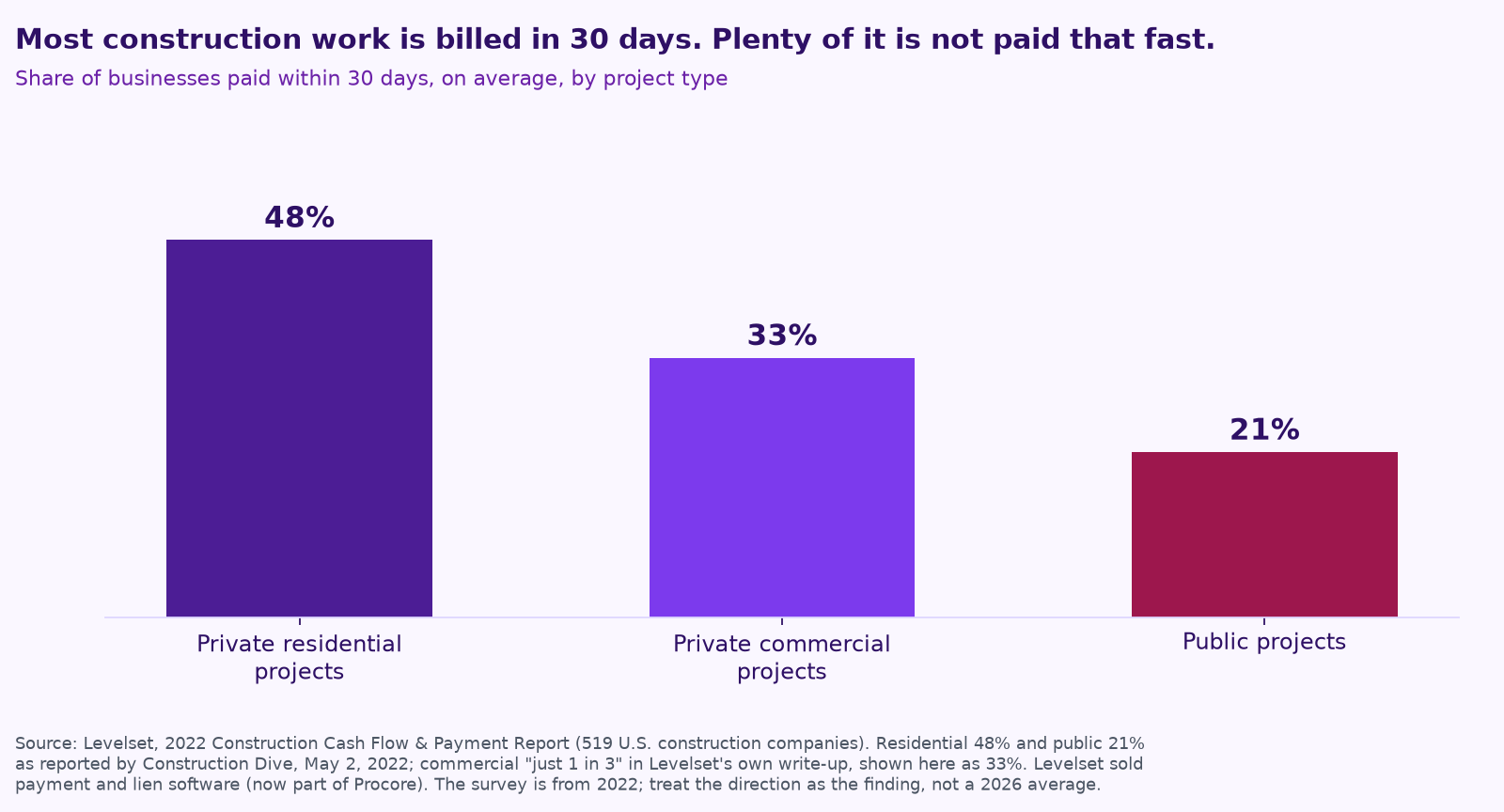
Levelset surveyed 519 U.S. construction companies for its 2022 Construction Cash Flow and Payment Report. Nearly 9 out of 10 companies offered payment terms of 30 days or fewer, but fewer than 4 in 10 reported getting paid within 30 days on average. Only about 12% said they were always paid on time, and 10% said the average customer took more than 60 days. Slow payments were blamed for wasted resources (45%), reduced profit (41%) and failure to meet payroll (18%) (Levelset).
The delays are not evenly shared. General contractors in the same survey were more than twice as likely as subcontractors to get paid within 30 days, and six times more likely than material suppliers. Construction Dive, reporting on the same study, noted that businesses on private residential work were paid within 30 days 48% of the time, compared with 21% on public projects (Construction Dive). Levelset sold payment and lien software and is now part of Procore, so treat the direction as the finding, not a 2026 average. The pattern is familiar on any job where money moves down a chain and each step needs a complete file.
What a complete pay app usually includes
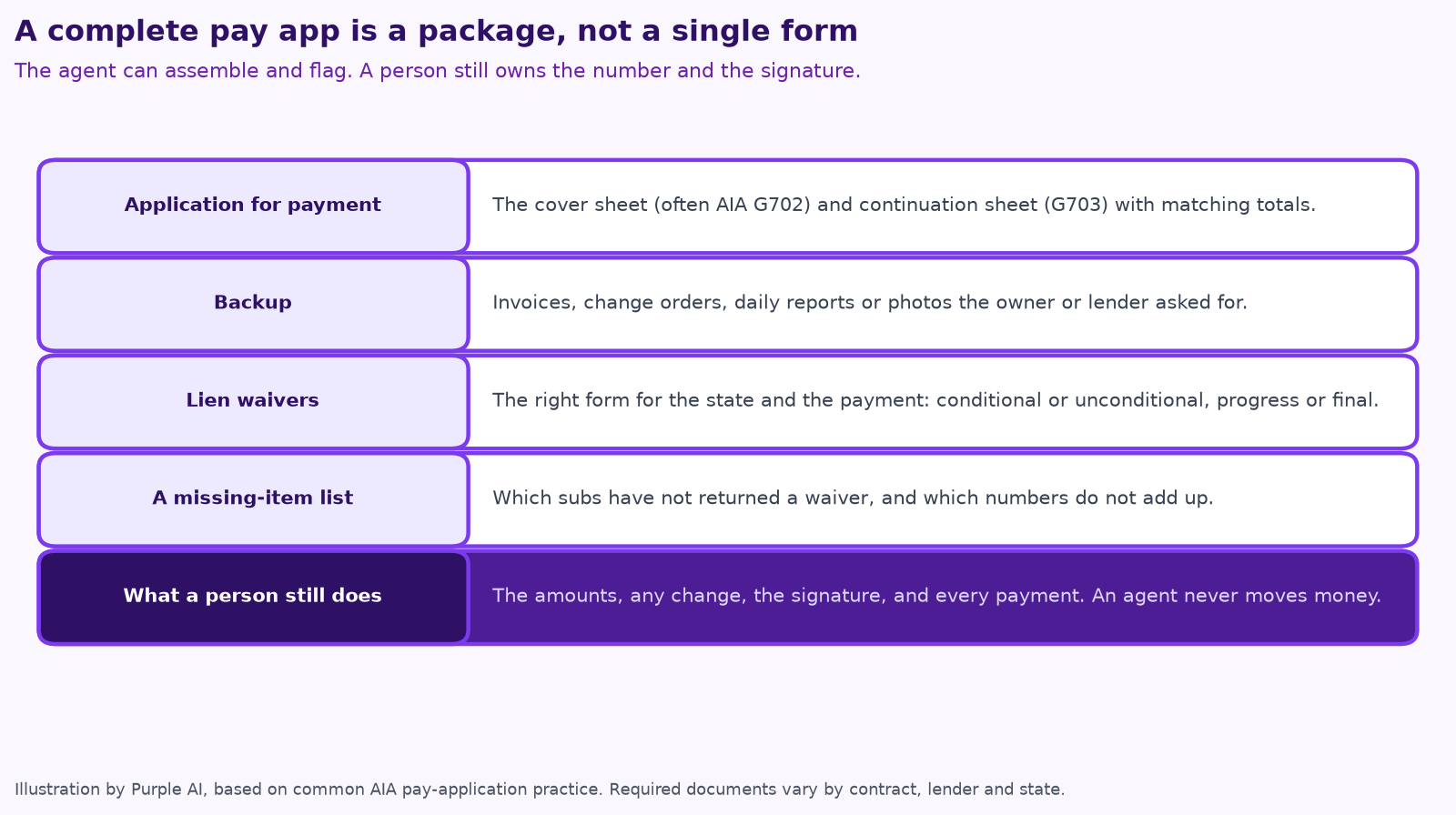
On many commercial jobs the package is built around AIA forms: G702, the application and certificate for payment, and G703, the continuation sheet, plus invoices, change orders, and the daily reports or photos the owner or lender asked for. AIA’s guidance is direct: required lien waivers should go with every payment application, and even when they are not explicitly required it is still a good idea to send them, because a missing waiver can delay payment or look like a red flag (AIA Contract Documents).
The waiver itself has to match the project and the payment. AIA describes four common types: conditional or unconditional, and progress or final. A conditional waiver is the usual choice before the money has arrived. An unconditional waiver is for payment that has already been made. Some states, including California and Florida, require statutory forms. Using the wrong form, or sending an unconditional waiver before the check clears, is how companies give up rights they still need.
Where an agent fits
The useful work is coordination, not judgment about what has been built.
- Assemble the package. Pull the cover sheet, continuation sheet, invoices, change orders and backup into one checklist, and flag when the totals do not match.
- Track waivers. Who owes a waiver, who has returned it, whether it is the right state form, and whether it is conditional or unconditional, progress or final.
- Draft reminders to subcontractors and suppliers, on the schedule you set, and escalate only the way you have approved.
- Build a missing-item list before the pay app goes out, so the first submission is complete.
What stays with you: the amounts, any change to a number, the signature, and every payment. An agent should never move money, never sign a waiver, and never send an unconditional waiver because a draft invoice looks paid. If your construction software already has pay-app or waiver tools, use those first; we covered that in where vendor AI fits next to an agent team. For the approval line, see how to keep a human in charge.
A monthly close checklist
- Two or three days before the pay-app date, the agent lists open waivers and unmatched backup.
- Reminders go out to the people who have not returned a form, in the language you approved.
- A person checks the schedule of values against work in place, retainage and change orders.
- The package goes out only when the missing-item list is clear, or when a person has accepted a documented exception.
- After payment, collect the unconditional waivers that now apply, and do not mark them done early.
If you want to put a dollar figure on the time this saves, use the hours-back method and measure days to get paid and how many pay apps went out complete the first time, not just hours in the office. Accounting firms chasing client documents have a cousin of this job in AI for accounting and bookkeeping firms.
Pay app and waiver checklist
- ☐ Cover sheet totals match the continuation sheet before anything is sent.
- ☐ Each payment has the matching waiver, in the correct state form.
- ☐ Conditional waivers go out before payment; unconditional waivers wait until the money is in.
- ☐ Reminders to subs are drafted by the agent and approved by a person.
- ☐ An agent never moves money or signs a waiver.
- ☐ We track how many packages go out complete on the first try, and days to get paid.
The same follow-through helps whether you are a general contractor, a specialty trade or a remodeler billing in stages. See AI for construction, the contractor AI checklist, AI for trades, and the pages for HVAC, plumbers, electricians, roofers and remodelers.
Keep reading
- 7 AI workflows for small contractors
- AI for construction safety documentation and toolbox talks
- How to keep a human in charge of AI agents
- Procore, ServiceTitan, Jobber and Buildertrend have AI now
- AI for accounting and bookkeeping firms
- How to measure AI agent ROI with the hours-back method
- AI for construction estimating and takeoffs
- What does fractional AI cost?
- AI for roofing storm-season leads and claim reports
- How to run an AI assessment for your small business in one week
How we do this at Purple AI
Purple AI is an AI consulting firm for small businesses, and we start with construction and trades. We set up a small team of AI agents inside the tools you already use, give each agent one job, and keep a person in charge of anything that matters. Then we stay on to tune it as your business and the AI tools change.
The easiest first step is a free 15-minute AI mini-audit. We’ll look at where your week goes and name the one or two jobs we’d hand to an agent first. Book your mini-audit here.
If it’s a fit, ongoing plans are Starter at $750 a month (one workflow or dashboard), Core at $1,000 a month (an ongoing agent team, our most popular plan) and Growth at $1,250 a month (agents across several departments). If you want a deeper look first, there’s an optional $2,500 assessment, and $1,000 of it is credited to your first month.
Sources
- Levelset, Construction Industry Booming, But Slow Payment Hurts Businesses: 2022 Survey Report (May 2, 2022), on the 2022 Construction Cash Flow and Payment Report (519 U.S. construction companies). Levelset sold payment and lien software and is now part of Procore.
- Construction Dive, Report: GCs more likely than subs to get paid on time (May 2, 2022), reporting additional breakouts from the same Levelset survey.
- AIA Contract Documents, Lien Waiver Best Practices for Pay Apps.
Free checklist
Find 10 hours a week: the AI checklist for contractors
30 places construction and trades businesses lose time every week, and what an AI agent can take off your plate. On the page or as a printable PDF.
Get the checklist →