

An AI draft is not a safety program. It can prepare a toolbox talk, a job hazard analysis and a sign-in sheet for the work you are actually doing this week. It cannot walk the site, watch a harness get clipped off, or sign a training record. The rule is simple, and it does not change: the agent drafts, and the safety lead signs.
We already listed safety documentation as one of seven workflows a small contractor can hand to an agent. This post goes deeper on that job: what the law actually requires you to keep, why the paperwork still matters, and how to use an agent without pretending it is a competent person.
Why the record matters
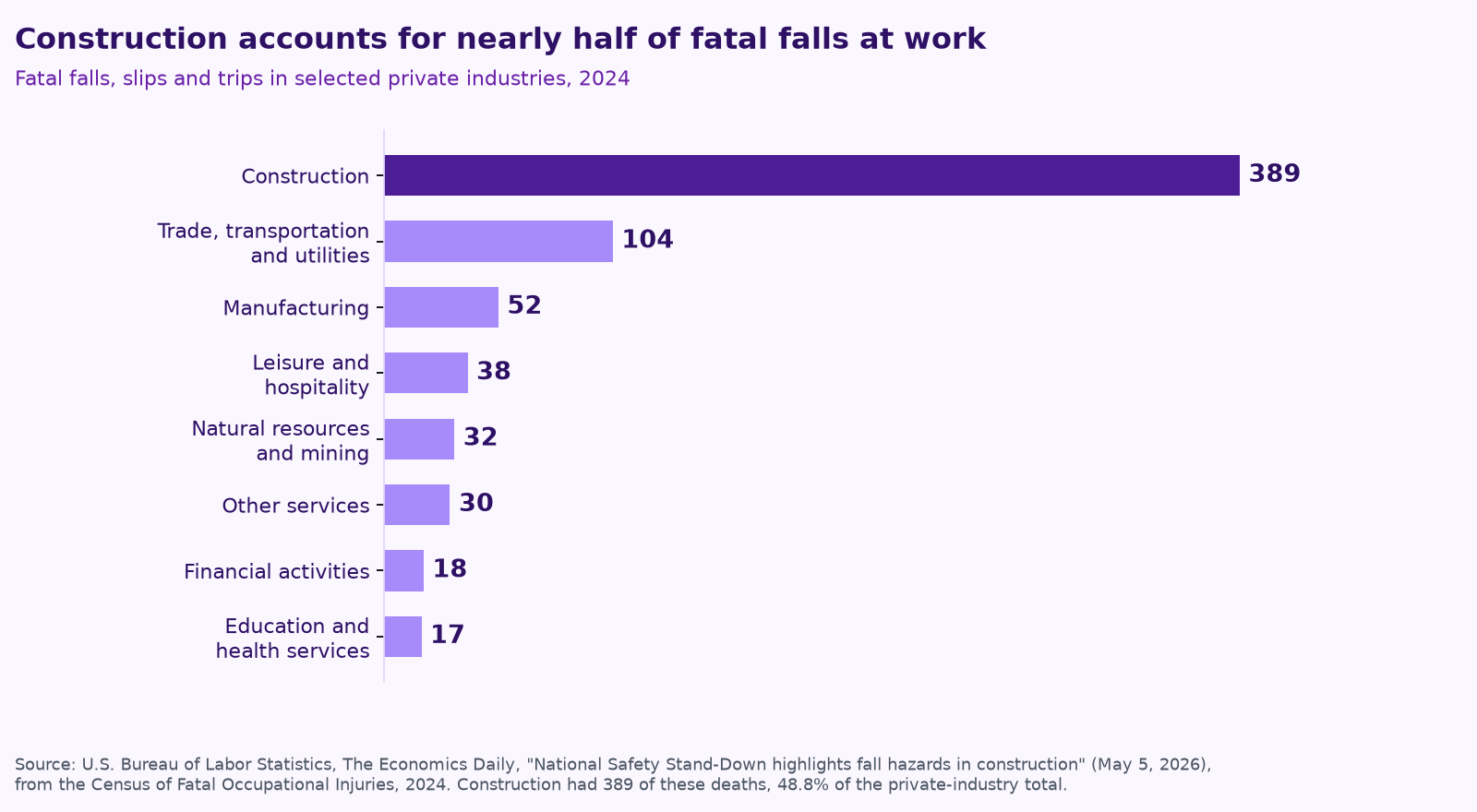
Falls remain the leading cause of death in construction. In 2024, the U.S. Bureau of Labor Statistics counted 1,034 workplace deaths in private-sector construction. Of those, 389 were falls, slips and trips, and 95.9% of that group were falls to a lower level. Construction accounted for 48.8% of all fatal falls, slips and trips in private industry that year (BLS). The fatal-injury rate in construction was 9.2 deaths per 100,000 full-time equivalent workers (BLS CFOI).
Nonfatal injuries tell a similar story. During 2023-2024, private-sector construction had 13.9 nonfatal falls to a lower level with at least one day away from work per 10,000 full-time workers, compared with 4.1 across all private industry (BLS). OSHA uses these figures in its fall-prevention campaign and its National Safety Stand-Down, a voluntary event where employers pause to talk with crews about fall hazards, often in the form of a toolbox talk (OSHA).
Paperwork does not prevent a fall. Training, equipment and supervision do. The record is how you prove the training happened, who was there, and who was qualified to give it.
What you actually have to document
Federal OSHA does not require a “toolbox talk” by that name. It does require training on specific hazards, and some of those rules are strict about the record. For fall protection, 29 CFR 1926.503 says the employer must provide a training program for each employee who might be exposed to fall hazards, taught by a competent person, and must verify it with a written certification record that includes the employee’s name or other identity, the date or dates of the training, and the signature of the person who conducted the training or of the employer. The latest certification has to be kept. Retraining is required when the work, the equipment or the employee’s skill has changed.
Some states go further on the regular talk itself. In California, construction employers must hold tailgate or toolbox safety meetings at least every 10 working days. Cal/OSHA’s guide says to document the topic, date, attendees and any actions taken, and to keep the meeting short, usually 10 to 15 minutes, on a topic that matches the work (Cal/OSHA). If you work in a state-plan state, follow that state’s rule, not just the federal one.
A generic handout titled “safety talk,” with no date, site, topic or signatures, is a weak record. A talk that was never written down is hard to prove at all.
Where an agent fits
This is a good agent job because it is frequent, it follows a format, and it is easy to check. In his November 2026 ENR column, Brantley Brumley used a daily safety report as the example of a short, reusable AI instruction: ask for the job number, crew size, weather and incidents, pull the day’s activities from the foreman’s notes, and “flag a missing toolbox talk” (ENR). That is the right level of ambition.
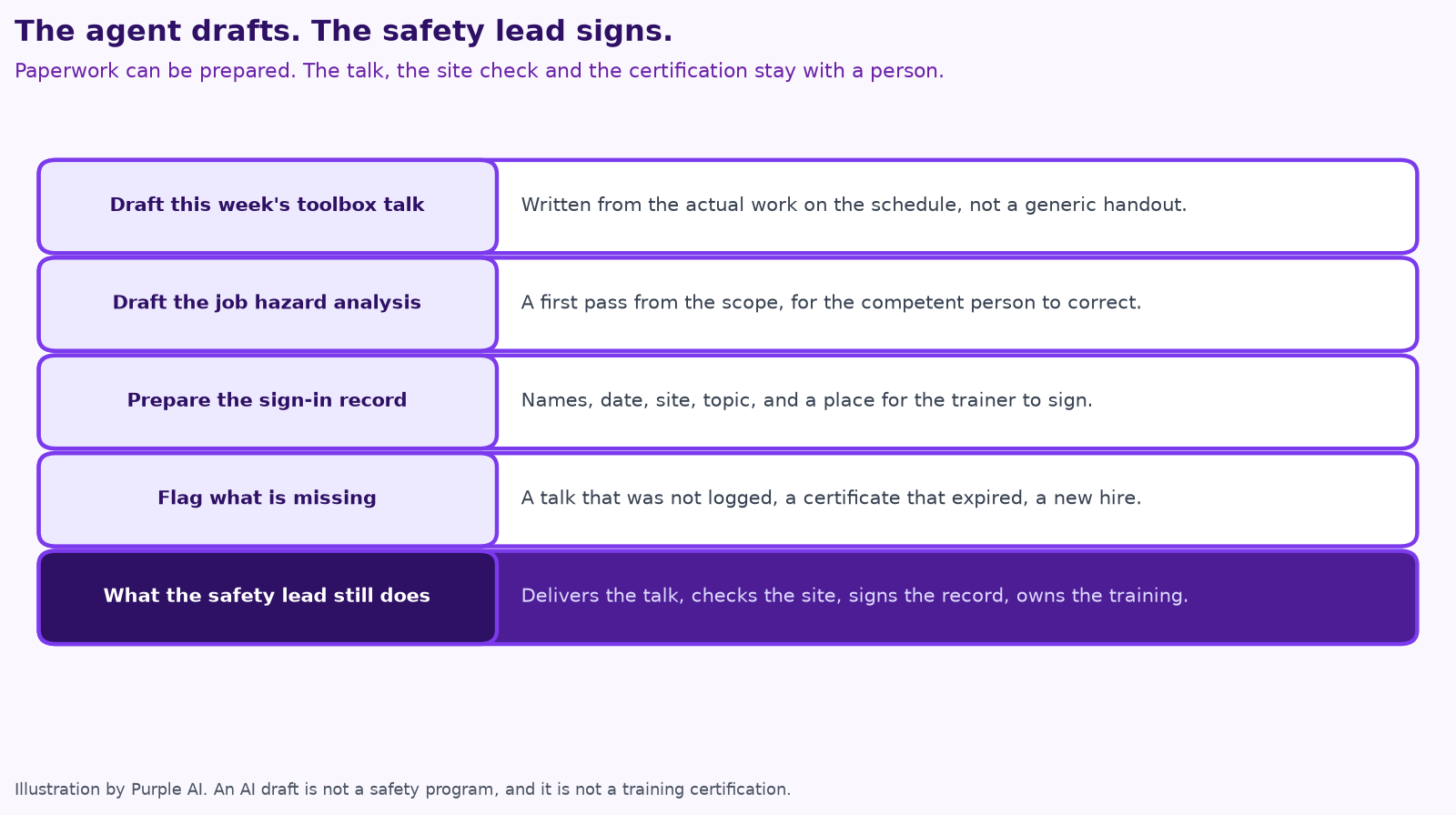
- Draft this week’s toolbox talk from the work actually on the schedule: roof work, a trench, a scaffold, a new chemical, a tight site. Not a random topic from a folder.
- Draft a job hazard analysis from the scope of work, for a competent person to correct against the real conditions.
- Prepare the sign-in and certification record: date, time, location, topic, relevant standard if you use one, presenter, attendee names, and a signature line for the trainer or employer.
- Flag what is missing: a talk that was not logged, a new hire who has not been trained, a certificate that is about to expire, a change in equipment that should trigger retraining under 1926.503(c).
The safety lead still delivers the talk, walks the site, answers questions, and signs. An agent should never put a signature on a training certification, and it should never invent site conditions it has not been given. If the draft is wrong about the work, throw it out and start from the scope. For the approval line, see how to keep a human in charge of AI agents.
A short weekly rhythm
- On Friday or Sunday, the agent drafts next week’s talks from the look-ahead schedule.
- The safety lead or superintendent edits them against the actual site, then gives the talk.
- Crew members sign. The signed record is stored where you can find it.
- Once a week, review the missing-item list: talks not logged, people not trained, certificates expiring.
Safety documentation checklist
- ☐ The talk matches this week’s work, not a generic handout.
- ☐ The record has the date, site, topic, presenter and attendee names.
- ☐ Fall-protection training certifications include the employee’s name, the date and the trainer’s or employer’s signature, as 1926.503 requires.
- ☐ A person, not the agent, delivers the talk and signs the record.
- ☐ Missing talks, new hires and expiring certificates get flagged every week.
- ☐ We do not treat an AI draft as proof that anyone was trained.
If you work on roofs, trenches, electrical rooms or occupied homes, the same drafting-and-signing pattern applies. Start with AI for construction, the contractor AI checklist, or the trade pages for roofers, HVAC, plumbers, electricians, remodelers and the trades. A written AI use policy should say outright that safety instructions and training records are always reviewed by a person.
Keep reading
- 7 AI workflows for small contractors
- How to keep a human in charge of AI agents
- AI for lien waivers and pay applications
- AI for roofing storm-season leads and claim reports
- AI for construction estimating and takeoffs
- A free AI use policy template for small businesses
- Give your AI agent a job, not a to-do list
- How to measure AI agent ROI with the hours-back method
- How to run an AI assessment for your small business in one week
- AI for dispatch and quotes: where trades shops save hours
How we do this at Purple AI
Purple AI is an AI consulting firm for small businesses, and we start with construction and trades. We set up a small team of AI agents inside the tools you already use, give each agent one job, and keep a person in charge of anything that matters. Then we stay on to tune it as your business and the AI tools change.
The easiest first step is a free 15-minute AI mini-audit. We’ll look at where your week goes and name the one or two jobs we’d hand to an agent first. Book your mini-audit here.
If it’s a fit, ongoing plans are Starter at $750 a month (one workflow or dashboard), Core at $1,000 a month (an ongoing agent team, our most popular plan) and Growth at $1,250 a month (agents across several departments). If you want a deeper look first, there’s an optional $2,500 assessment, and $1,000 of it is credited to your first month.
Sources
- U.S. Bureau of Labor Statistics, National Safety Stand-Down highlights fall hazards in construction, The Economics Daily (May 5, 2026), from the Census of Fatal Occupational Injuries, 2024, and the Employer-Reported Workplace Injuries and Illnesses program.
- U.S. Bureau of Labor Statistics, Number and rate of fatal work injuries, by selected private industries, 2024.
- Occupational Safety and Health Administration, National Safety Stand-Down to Prevent Falls in Construction, and 29 CFR 1926.503, Training requirements.
- California Department of Industrial Relations, Cal/OSHA, How to set up a tailgate/toolbox meeting, citing Title 8, California Code of Regulations, Section 1509.
- Brantley Brumley, Engineering News-Record, Contractors Don’t Need an AI Strategy, They Need an AI Owner (Nov. 18, 2026).
Free checklist
Find 10 hours a week: the AI checklist for contractors
30 places construction and trades businesses lose time every week, and what an AI agent can take off your plate. On the page or as a printable PDF.
Get the checklist →