
If your business uses AI agents, there’s a decent chance you’re paying top-shelf prices for work that doesn’t need it. Sorting leads, drafting reminders, pulling numbers off an invoice, turning a foreman’s voice note into a form: none of that calls for the most powerful AI model on the market. Yet a lot of setups send every one of those jobs to the biggest model they can get.
That’s the finding behind a new report from the Wharton School and Accenture, What Does Agentic AI Really Cost?, published November 16. Fortune summed it up in a headline: most work doesn’t need “the Ferrari of AI,” but companies may be paying for it anyway. Practitioners on X have been chewing on the same idea all week, from small teams copying Uber’s cost playbook to engineers arguing about when a cheaper model actually saves money.
The practical thesis for a small or mid-size business: decide which model does which job before you build the agent, test that choice on your real work, and measure cost per finished task instead of price per token. Here’s what the research found, what it means for a contractor or trades shop, and the honest catches.
What Wharton and Accenture actually found
The researchers started with more than 18,000 tasks and work activities across 923 occupations, from the U.S. government’s O*NET job database. They kept the 11,339 tasks an AI agent could plausibly take on, then scored each one on five kinds of complexity: how many interdependent steps it has, whether legal, regulatory or audit rules apply, how many computer systems it touches, whether it needs sensitive data, and how much fresh data it depends on (full report, PDF).
The headline numbers:
- More than 90% of tasks fell into lower-complexity categories that generally don’t require a frontier (top-of-the-line) model.
- Complex work was only 6% to 11% of the agent-ready work volume within each of the 19 industries studied.
- The demanding tasks also tend to be the rare ones: in most industries, the more capability a task needs, the less often it happens.
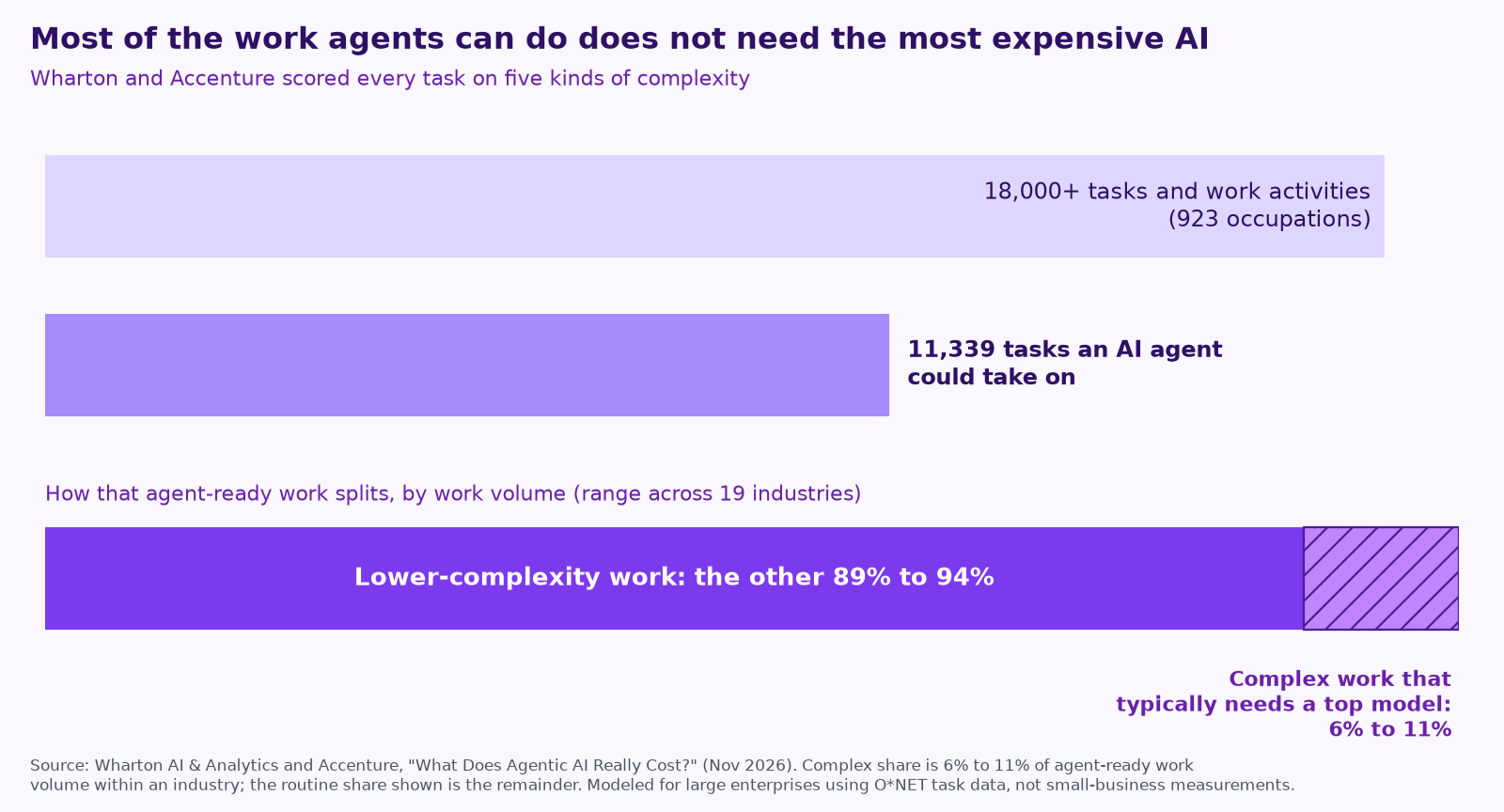
The examples in the report make the split easy to picture. Low-complexity tasks included writing advertising and promotional material and preparing invoices and reports. High-complexity tasks included drafting and reviewing legal documents like contracts, and building quality-control systems.
Eric Bradlow, Wharton’s vice dean of AI and analytics and a coauthor, told Fortune he doubts most companies make the distinction at all: “I think they’re taking possibly their most sophisticated model and applying it to all of the workflow.” His coauthor James Crowley of Accenture put the problem more simply:
“The model choice often happens too late. People tend to use the model that they already have access to rather than what’s best suited to the task.”
James Crowley, Accenture, in Fortune
Crowley was also clear that “it’s not an argument against frontier models. They remain essential for complex, specialized, high-stakes work.” The point isn’t to go cheap. It’s to stop paying premium rates for routine work.
Why it matters even if you’re not a big company
The report models huge enterprises, so don’t borrow its dollar figures. But the price gap between models is something any business can see. Here’s one vendor’s current lineup, using Google’s published Gemini API prices:
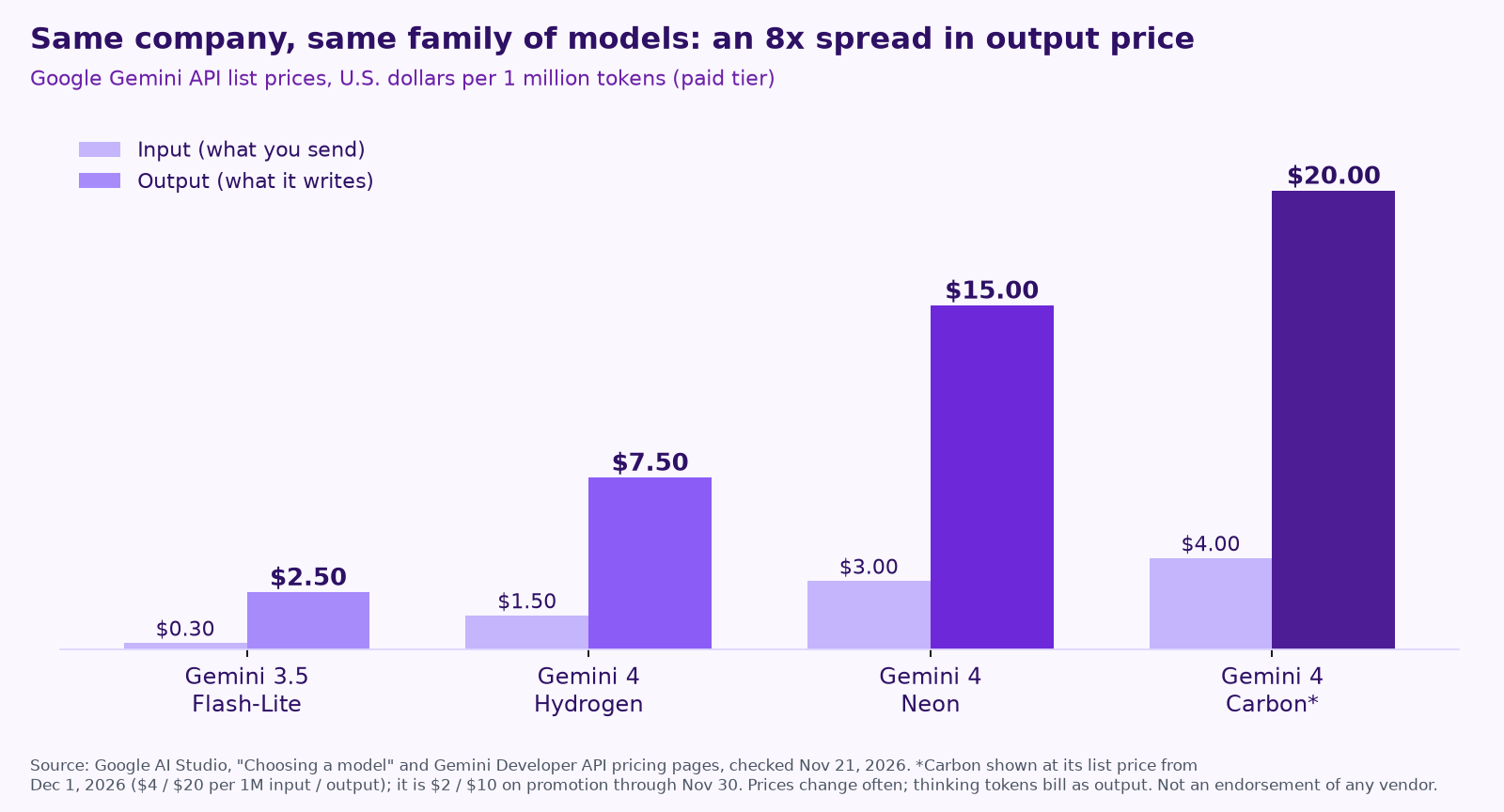
From the lightest model to the heaviest, the output price goes up eight times. And the price can move under you: Google’s top Carbon model doubles from $2 / $10 to $4 / $20 per million tokens on December 1, when its introductory price ends. If an agent quietly runs everything on that model, your bill doubles without anyone changing a thing.
Google’s own developer guide says the quiet part out loud: “You don’t have to pick one model for your whole app.” It suggests pairing a stronger model for the hard first step with a faster, cheaper one for the follow-through, and adjusting how much “thinking” a model does before you switch models at all. (Thinking is billed too. Google’s pricing page notes that output prices include thinking tokens.)
A real-world example: Uber held AI spend flat while usage grew more than 9x
The best-documented case this year comes from Uber. In an August engineering post, distinguished engineer Uday Kiran Medisetty wrote that weekly agent requests across the company grew 9.4x from February to August 2026, while total AI spend “relatively stabilized since April.” Holding one model fixed, cost per 1,000 requests fell almost 34% from its peak.
How? Matching models to work was one piece: Uber picks the model for each managed agent by building a benchmark from that agent’s real work and judging on cost per completed task, output quality and reliability. The other pieces were plain housekeeping. Axios reported that Uber caps interactive sessions at 400,000 tokens even on models that can take a million, and The Stack reported that just over 100 connected tools added roughly 50,000 to 70,000 tokens to every session before any work started.
Jose Medina, cofounder of Tessera, read the Uber post and summed up what carries over to a team of three:
Uber’s weekly AI agent requests grew more than 9x between February and August. Their AI spend has stayed roughly flat since April.
We run agents all day, so I read how they did it closely. Most of it works for a team of three
— Jose Medina (@jose_medina) November 20, 2026
Uber is clear that its numbers are specific to its own codebase and workflows. The method is what transfers: measure real work, break the bill into parts, fix the biggest part first.
What this looks like in a construction or trades business
Here’s a starting map for the kinds of jobs contractors and service companies hand to agents. These are our examples, not findings from the report, and the right tier depends on testing with your own work.
| Job | What makes it hard (or not) | Start with | Who checks |
|---|---|---|---|
| Sorting web leads by trade and zip code | One step, clear rules | Lightest model | Spot-check weekly |
| Appointment reminders and quote follow-ups | Short, repetitive, uses your template | Lightest model | Approve before sending |
| Voice note to daily log, invoice to spreadsheet | Pulling facts into fixed fields | Light or mid model | Super or bookkeeper signs |
| Summarizing a long email thread with a GC into action items | Lots of context, some judgment | Mid model | PM reads it |
| Finding scope gaps across a bid package | Many documents, many steps, costly if wrong | Top model | Estimator owns the number |
| Flagging payment or indemnity terms in a subcontract | Legal and money risk | Top model | Owner, and your attorney |
Notice the pattern. The cheap jobs are the ones you do dozens of times a day. The expensive ones happen a few times a month. That’s exactly the shape Wharton and Accenture found: high volume, low complexity at the bottom; low volume, high stakes at the top.
The honest catches
A cheaper model that needs more fixing isn’t cheaper
If the light model gets a lead summary wrong one time in five and someone has to redo it, you’ve saved pennies and spent an hour. One builder on X listed what an agent task really costs: the model bill, retries, someone building it, someone reviewing it, someone fixing it, and the tasks that never get accepted. Another made the same point: compare cost per completed task, because retries and longer answers can erase a lower sticker price.
Switching models mid-job can backfire
The report itself warns that “dynamic model routing is difficult to track in live operations, and few enterprises can run it at scale.” For a small business that’s good news, really. You don’t need a clever system that picks a model on the fly. Decide per job, write it down, and leave it alone until you have a reason to test again.
Your total bill can still go up
Bradlow told Fortune that per-task costs are falling, but “I’m asking it to do 100 different things I wasn’t asking it to do a year ago. So my total cost is going up.” That’s fine if each new job earns its keep. It’s why the report recommends tracking AI cost next to the value it creates, which it calls an AI P&L. Its other warning worth repeating: the first agent costs the most, and the report suggests a 15% to 25% contingency because real projects run over.
Benchmarks aren’t your business
The Wharton and Accenture complexity scores were produced by AI models rating job descriptions, across large enterprises. Vendor rankings are vendor rankings. The only test that counts is your own work.
A simple checklist before your next agent goes live
- List the jobs. Write down each task the agent will do and roughly how often.
- Sort by stakes. Mark anything involving money, contracts, safety or regulations as high stakes. Those get the strongest model and a named person who signs off.
- Start routine jobs on a lighter model. Run 20 or so real examples side by side with the bigger model and compare the results.
- Count cost per finished task, including the time someone spends fixing mistakes.
- Trim the overhead. Connect only the tools the agent needs and start fresh sessions instead of dragging long histories along.
- Check prices monthly. Promotions end and new models arrive. Put a calendar reminder on it.
For more on putting numbers on an agent, see our hours-back method for measuring AI agent ROI. If you’re weighing one agent versus a team of them, your AI team shouldn’t copy your org chart covers why more agents usually means more tokens. And for the sign-off side, read how to keep a human in charge of AI agents.
Where Purple AI fits
Purple AI builds and runs AI agent teams for construction and trades businesses, inside the tools you already use, including ChatGPT and Claude. A person signs off on what matters. If your AI bill is creeping up, or you’re not sure whether a job needs the expensive model, bring that question to a free 15-minute mini-audit at gopurple.ai.
Sources
- Wharton AI & Analytics and Accenture, What Does Agentic AI Really Cost? A Task-Level Framework for Enterprise Investment (Nov 2026), and the Knowledge at Wharton special report page.
- Amanda Gerut, Fortune, Most work doesn’t need the Ferrari of AI, Wharton and Accenture find, but companies may be paying for it anyway (Nov 16, 2026).
- Google AI Studio, Choosing a model and Gemini Developer API pricing (checked Nov 21, 2026); Google, Gemini 4 Carbon is now available (Nov 10, 2026).
- Uday Kiran Medisetty, Uber Engineering, Running a Software Factory Efficiently at Uber Scale (Aug 27, 2026).
- Axios, Exclusive: Uber cuts AI costs even as usage jumps (Aug 27, 2026).
- The Stack, 1,000 MCP servers, no schema bloat? Uber attacks AI costs.
- Jose Medina (@jose_medina), post on X about Uber’s agent costs (Nov 20, 2026).
- @curious_queue, post on X on what an agent task actually costs (Nov 20, 2026).
- @read__the__diff, post on X on cost per completed task (Nov 20, 2026).
Free checklist
Find 10 hours a week: the AI checklist for contractors
30 places construction and trades businesses lose time every week, and what an AI agent can take off your plate. On the page or as a printable PDF.
Get the checklist →
