
Anthropic just published something rare in AI: not a benchmark or a forecast, but 66 conversations with people at 58 U.S. companies about what actually happened when they put AI to work. The interviewees included dentists, accountants, structural engineers, law firms, a property manager, a trucking company and a publisher. Together they described nearly 300 real AI uses.
The headline finding is simple, and it’s good news for small businesses: the biggest payoffs didn’t come from buying the smartest tool. They came from changing who does what. The companies that got the most out of AI redrew jobs around it. The ones that just handed out logins got pockets of cool stuff, and a lot of AI-written work nobody had time to check.
That second part is the practical lesson for an owner with 10 or 50 people. Here’s what the report found, why “checking the work” turned out to be the real bottleneck, and a simple way to rearrange your own work around AI agents without a big reorganization.
What Anthropic heard from 58 companies
The report, “Working with AI,” came out November 23, 2026 from Anthropic’s economics team (Nathan Wilmers, Maxim Massenkoff and Peter McCrory). One caveat up front, which the authors make themselves: every company was an Anthropic customer, picked for variety, not chosen at random. So treat it as field notes from companies already using AI, not a census of American business.
With that in mind, a few findings stand out:
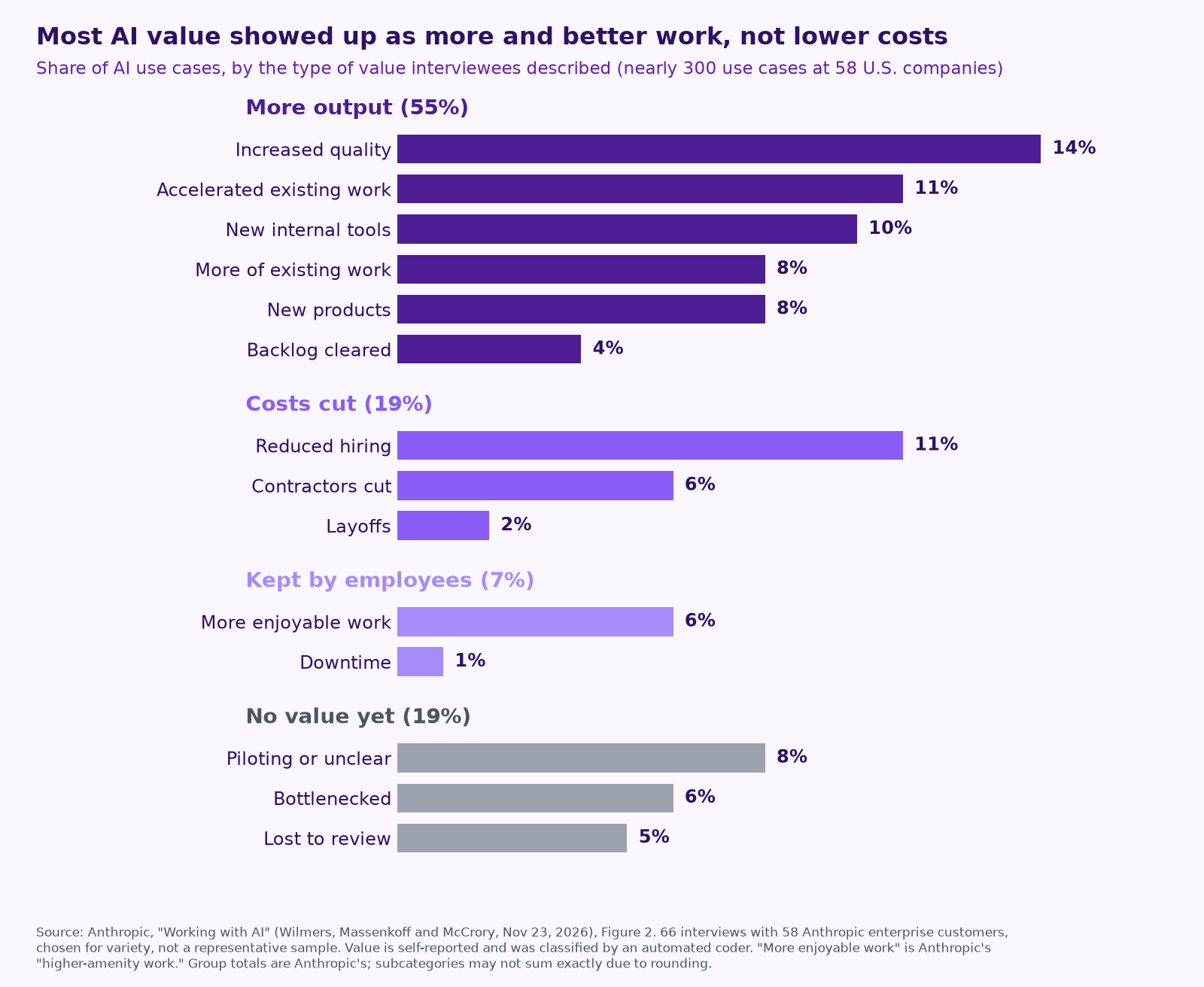
- Most value came from doing more, not spending less. Of the uses where interviewees described what they got out of AI, 55% increased output or quality: better work, faster work, new internal tools, even new products. Cost cuts accounted for 19%.
- Almost one in five uses (19%) had produced no value yet. Some were still pilots or unclear, some got stuck behind other parts of the business, and 5% lost their time savings to reviewing the AI’s work.
- Few layoffs, but less hiring. Only two companies had seen AI fully eliminate a position. But people at two-thirds of the companies said they were hiring less because of AI. As one put it, “We may not be firing, but we’re not hiring.” Ten companies said they had hired more because of AI, mostly to implement it and support IT.
- The highest-value uses came with real changes to roles and processes. Light-touch uses, like ad hoc data analysis or slide decks, fit into the existing setup but were often rated low value.
Ethan Mollick, the Wharton professor who studies AI at work, boiled it down to two points:
Two big points from this new Anthropic paper:
1) The most AI value comes from changing the organization
2) There is wide worker resistance to AI adoption (partially due to point 1)Changes that expand what workers do & share AI gains with them could help
— Ethan Mollick (@emollick) November 23, 2026
The bottleneck nobody budgets for: checking the work
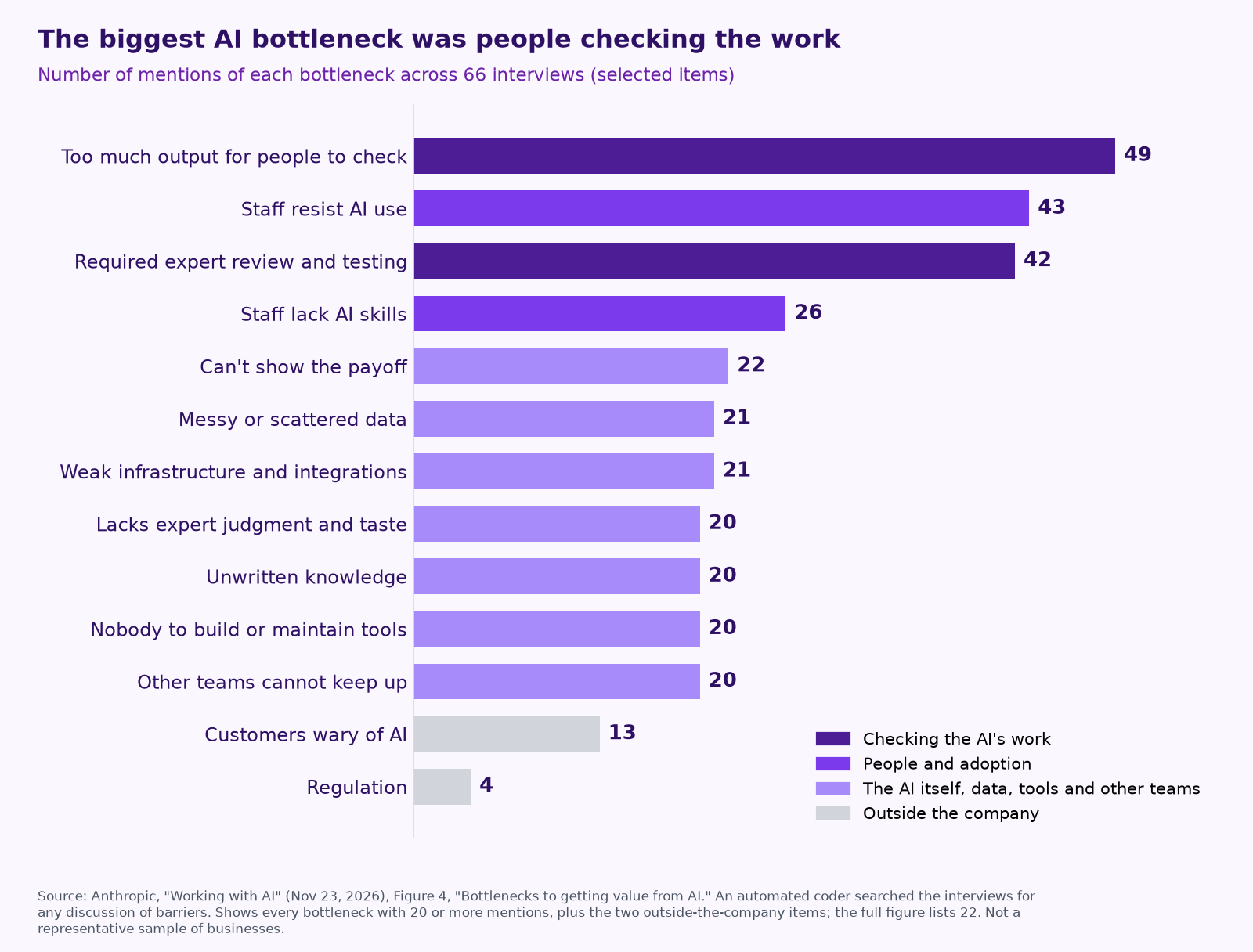
When the researchers tallied every obstacle people mentioned, the top one wasn’t cost, regulation or skeptical customers. It was “too much output for people to check” (49 mentions), followed closely by staff resisting AI (43) and work that required expert review and testing (42). Regulation came up 4 times. Customers being wary of AI came up 13 times.
In plain words: AI made it cheap to produce drafts, reports, code and emails. It did not make it cheap to read them. The report has a few painful examples. An agent added one stray “S” to a web address in some code and broke a carefully planned feature release. An equipment maker realized AI could translate its product text into 10 languages, then turned the feature off before shipping because, as an engineer put it, “we don’t have anybody that can answer the phone in those languages.” Power users at some firms flooded coworkers with AI-written memos, and skeptics answered, “Guys, I’m not reading your AI email.”
This is why “give everyone a ChatGPT login” often disappoints. The drafting gets faster, but the person who has to check, approve or act on the draft is still working at the old speed. The work just piles up at their desk.
“Not ‘Claude, write the email,’ but, ‘Why are you even getting the email?'”
The head of AI at an investment firm, quoted in Anthropic’s report, on the difference between speeding up a task and rethinking the work.
Two common approaches, and where each one stalls
The report describes two ways companies usually start, and both run into trouble.
Top-down: pick a workflow and automate it
Leadership chooses a process and rolls out an AI system. It can work, but it scared the experts whose knowledge was needed to make it work. One employee described it as “building my own coffin.” At one law firm, a well-built conflict-check agent pushed hard cases onto staff who hadn’t handled them before. The staff pushed back, the agent was shelved, and the firm went back to its old process. Many vendor-built, single-purpose tools also aged quickly as models improved. “It’ll be obsolete in three months,” one employee said of one system.
Bottom-up: hand out tools and see what happens
Here, a few enthusiastic people do amazing things. An accountant built an app for a 401(k) payment audit that used to take 80 hours. But wins like that tended to stay personal: the 401(k) app had to be implemented by an outside vendor and still wasn’t in active use months later.
Box CEO Aaron Levie has been seeing the same split, where teams inside one company get very different results:
Even within the same company you can have a 10X delta between the lowest and highest adopters of AI and the impact they’re seeing. The teams that are able to actually figure out how to redesign their processes to best deploy agents in their workflows can see up to an order of magnitude jump in productivity depending on the job function.
— Aaron Levie (@levie) November 24, 2026
That’s an excerpt from a longer post, and “10X” is Levie’s estimate, not a measured figure. But it matches what Mollick said he’s hearing from big firms: small teams of two or three people using AI to do the work of dozens, and fights over what that means.
What “reorganizing around AI” looks like in a small business
The good news for a small company: you don’t have management layers to untangle. Reorganizing can be as small as changing who drafts, who checks and who signs on a handful of jobs. The report describes three moves, and each one translates.
1. Give one person the whole job, not a slice of it
Companies got more from AI when one person or a small team owned a whole workflow from start to finish, instead of handing it across departments. One executive merged lead sourcing, sales and customer success into one role that handles the whole customer life cycle. In a small business, that might mean one person owns “estimate to signed contract,” with AI agents doing the drafting and chasing in between.
2. Move people to the part AI can’t do yet
At one construction company in the report, project managers used to call crews at each site every morning and write up a daily report for customers. Now an AI agent pings the crews, who “talk to the robot.” It drafts the report from their answers and past reports. The project managers got their mornings back to talk with customers about more pressing needs. The job didn’t disappear; it moved to where people matter most.
3. Make checking a real job, with real time
Since review was the top bottleneck, treat it like work, not an afterthought. One engineer in the report read every transcript of his new AI agent for two months, fixing prompts and filling in missing information. Six months in, he still sampled transcripts every two weeks. That’s the honest cost of an agent that runs well. We wrote more about designing that step in how to keep a human in charge of AI agents.
A fourth move showed up too: put your business data where people (and agents) can use it. A trucking company built a data warehouse its AI agents could reach, and managers started running their own analyses. Before, a request “would have ended up on the queue, sometimes a year or two.”
| AI bolted on | Work rearranged around AI |
|---|---|
| Everyone gets a login; results depend on who’s curious | A few named jobs, each with an owner from start to finish |
| AI drafts pile up on one busy person’s desk | Review time is scheduled, and someone is accountable for it |
| Time saved quietly disappears | Time saved is pointed at customers, sales or the next bottleneck |
| Personal apps nobody else can maintain | Shared tools and data, with someone responsible for upkeep |
| Staff worry AI is coming for their jobs | Staff know which part of their job grows, and share in the gains |
The honest hard parts
- People’s fears are real, and they show up as resistance. Staff resisting AI was the second most common bottleneck. Mollick’s point applies to a 12-person shop as much as a bank: expanding what people do and sharing the gains helps. Being clear about it helps too.
- Homegrown tools aren’t free. An operations director at a large law firm weighed building a recruiting dashboard with AI and called it “small beans”: off-the-shelf software runs maybe “$30 a month, $50 a month, $100 a month,” and a homemade version needs someone to maintain it.
- The ground keeps moving. “You wait three months, and something new you didn’t think AI could do is now possible,” an HR manager said. Build plans you can revise, not one big fixed system.
- “Hiring less” is a real trade-off. For a growing small business, adding capacity without adding headcount can be the whole point. It’s still worth deciding on purpose what the people you have will do with the time.
- This is one study. It’s interviews, not a survey. Anthropic says its companies are larger than the average AI-adopting firm and lean toward software and finance, and the value figures are people’s own descriptions, not controlled tests.
A short checklist for this month
- Pick one workflow where drafts already pile up: estimates, follow-ups, daily reports or invoices.
- Write down who drafts, who checks and who signs today. Then decide who will do each once an agent does the drafting.
- Give the checker real time on the calendar, and a short list of what to look for.
- Name one owner for the whole job, start to finish.
- Decide where the saved time goes: customers, sales, training or the next bottleneck.
- Tell your team the plan before you roll anything out, including what isn’t changing.
- Review after 30 days: what got faster, what piled up, and what to change. Our guide to measuring AI agent ROI can help.
If you want a picture of how the roles fit together, see our post on drawing an org chart for your AI agent team. The point isn’t more AI. It’s a clear answer to “who does what now?”
How Purple AI can help
This is how we already work. Purple AI builds and runs AI agent teams for construction, trades and other small and mid-sized businesses, inside the tools you already use. Agents draft the work, and a person on your team approves anything that matters before it goes out. If you’d like help picking the first workflow to rearrange, and deciding who checks what, book a free 15-minute AI mini-audit at gopurple.ai.
Sources
- Nathan Wilmers, Maxim Massenkoff and Peter McCrory, Anthropic, Working with AI (Nov 23, 2026), including Figures 2 and 4 and the methods appendix in the report PDF.
- Ethan Mollick (@emollick), post on X about the Anthropic paper (Nov 23, 2026) and post on small AI-enabled teams at big firms (Nov 24, 2026).
- Aaron Levie (@levie), post on X about AI adoption gaps within companies (Nov 24, 2026).
- The Decoder, Anthropic study shows the hardest part of adopting AI at work has little to do with learning the tools (Nov 2026).
Free checklist
Find 10 hours a week: the AI checklist for contractors
30 places construction and trades businesses lose time every week, and what an AI agent can take off your plate. On the page or as a printable PDF.
Get the checklist →
