

Closeout goes badly when the punch list starts in the last week. An AI agent can keep a running list from walkthrough notes, photos and emails, track what is still open, and assemble the closeout packet so warranties, manuals, as-builts and lien waivers are not hunted down at the end. It should not declare a room finished or tell an owner the work is complete. A person still walks the job, makes the quality call and signs.
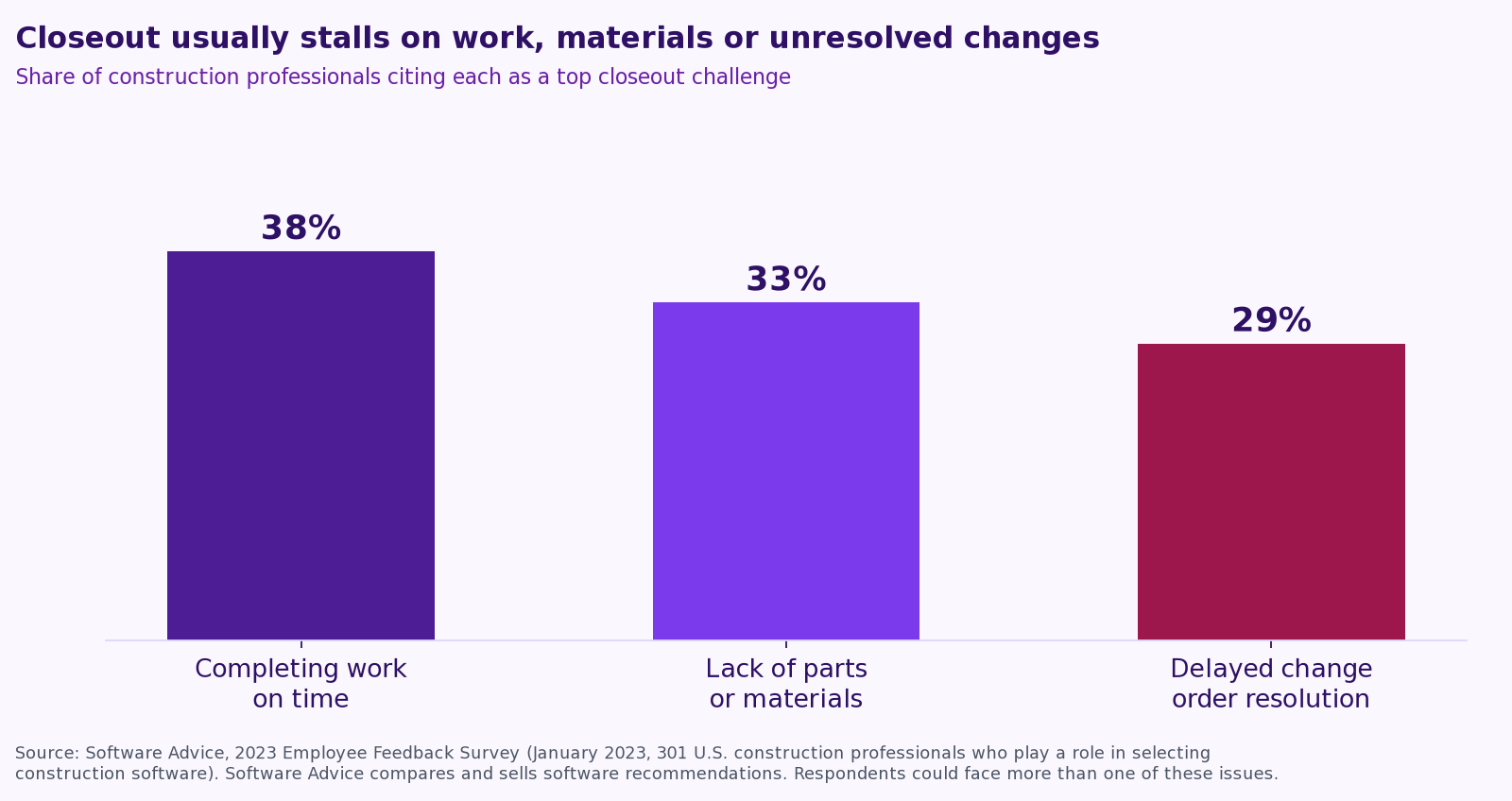
Closeout usually stalls on work, materials or unresolved changes
Software Advice surveyed 301 U.S. construction professionals in January 2023, all of whom played a role in selecting construction software. The leading closeout challenges they cited were completing work on time (38%), a lack of parts or materials (33%), and delayed change-order resolution (29%) (Software Advice, January 2023). Respondents could face more than one of these issues. Software Advice compares and sells software recommendations, so treat the exact shares as a survey of its audience, not a census of every job. The direction is still familiar: the last week is when leftover work, missing parts and unsigned changes all show up at once.
The same survey write-up, quoting Ben Gagnon, then head of preconstruction at SnapADU, makes the practical point: start compiling the list of items that need to be addressed as early as you can, and deal with change orders as they come instead of letting them pile up for the final walkthrough. That is a workflow problem, not a software feature.
The punch list is a running document, not a last-week scramble
A punch list is the agreed list of incomplete or incorrect work that has to be finished before the owner signs off. It should start as soon as rooms or areas are substantially complete, not the morning of the final walkthrough. Each item needs a location, a trade, a photo if there is one, an owner, and a status: open, assigned, waiting on a part or a decision, or done. When a change is still unsigned, it does not belong on the punch list as if it were already in the contract. It belongs on the change log until a person prices it and the owner approves it.
The closeout packet is the other half of the same job. Warranties, operation manuals, as-built drawings, extra materials lists, and the lien waivers that have to travel with final payment all need a home before anyone asks for them. For the waiver and pay-application side of that packet, see AI for lien waivers and pay applications. Required documents vary by contract, lender and owner, so the agent’s job is to track your checklist, not to invent one.
Where an agent fits
Use the punch-list and document tools in the project software you already pay for first. Then give the agent a narrow job: keep the list current and the packet together.
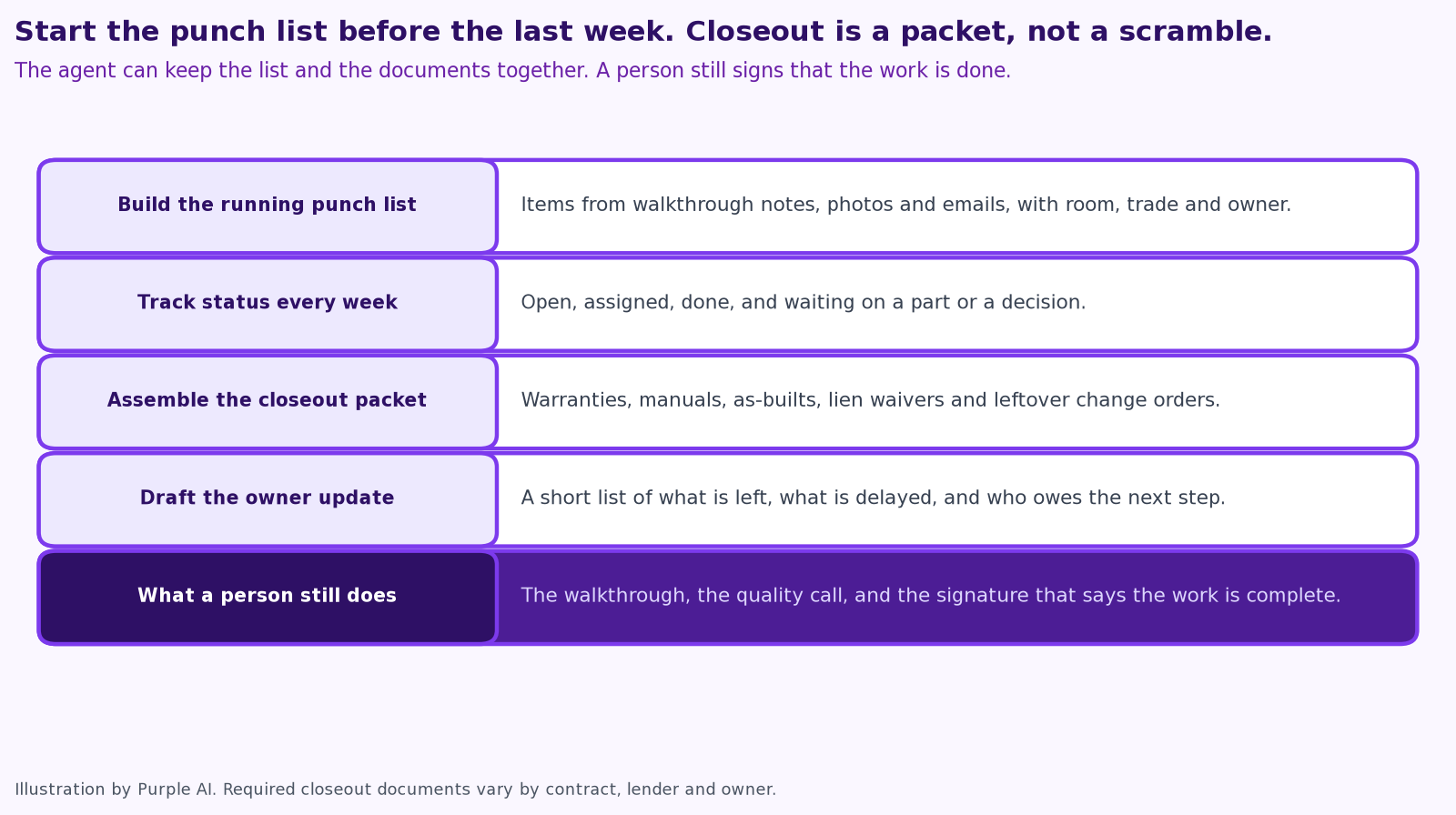
- Build the running punch list from walkthrough notes, photos and emails, with the room, the trade and an owner on each item.
- Track status every week: open, assigned, done, and waiting on a part or a decision.
- Assemble the closeout packet: warranties, manuals, as-builts, lien waivers and leftover change orders, flagged when a required document is still missing.
- Draft the owner update: a short list of what is left, what is delayed and who owes the next step, for a project manager to send.
What a person still does
The project manager or superintendent still walks the site, decides whether an item is actually complete, and signs that the work is done. The agent should not mark a punch item complete from a photo alone, tell an owner the job is finished, or release final payment paperwork. Quality is a human call. See how to keep a human in charge and our AI use policy template.
A short weekly scoreboard
Pick a few numbers you can review while the job is still open, not only in the last week:
- Open punch items, by trade and by how long they have sat.
- Items waiting on a part, a decision or an unsigned change.
- Closeout documents still missing from your checklist.
- Owner updates drafted and waiting for a person to send.
If you want to measure the office time this gives back, use the hours-back method on list-keeping and packet assembly, not on a finish date you cannot clearly attribute to the agent.
Punch list and closeout checklist
- ☐ The punch list starts as areas become substantially complete, not in the last week.
- ☐ Each item has a location, a trade, an owner and a status.
- ☐ Unsigned changes stay on the change log until a person prices them and the owner approves.
- ☐ The closeout packet has a checklist, and missing warranties, manuals, as-builts or waivers are flagged early.
- ☐ A person walks the job, makes the quality call and signs that the work is complete.
- ☐ The agent does not mark work complete from a photo or tell the owner the job is finished.
This is a construction and remodeling workflow first. Start with AI for construction and AI for remodelers, then trades, HVAC, plumbers, electricians, roofers and the contractor AI checklist.
Keep reading
- 7 AI workflows for small contractors
- AI for lien waivers and pay applications
- AI for construction RFIs and submittals
- AI for remodelers
- How to keep a human in charge of AI agents
- Procore, ServiceTitan, Jobber and Buildertrend have AI now
- How to measure AI agent ROI with the hours-back method
- AI for construction estimating and takeoffs
- AI for good-better-best service quotes
- How to run an AI assessment for your small business in one week
How we do this at Purple AI
Purple AI is an AI consulting firm for small businesses, and we start with construction and trades. We set up a small team of AI agents inside the tools you already use, give each agent one job, and keep a person in charge of anything that matters. Then we stay on to tune it as your business and the AI tools change.
The easiest first step is a free 15-minute AI mini-audit. We’ll look at where your week goes and name the one or two jobs we’d hand to an agent first. Book your mini-audit here.
If it’s a fit, ongoing plans are sized by who uses them: Starter at $1,000 a month for the owner (one person, one tool), Team at $5,000 a month for one department, and Enterprise starting at $10,000 a month for an organization-wide project. If you want a deeper look first, there’s an optional $2,500 assessment, and $1,000 of it is credited to your first month.
Sources
- Andrew Conrad, Software Advice, Nail Your Construction Project Closeout Every Time With These Tips (January 30, 2023), including findings from Software Advice’s 2023 Employee Feedback Survey, conducted in January 2023 among 301 U.S. construction professionals who play a role in their firm’s selection or purchase of construction software. Software Advice compares and sells software recommendations. The article also quotes Ben Gagnon, then head of preconstruction at SnapADU, on starting the closeout list early and addressing change orders as they come.
Free checklist
Find 10 hours a week: the AI checklist for contractors
30 places construction and trades businesses lose time every week, and what an AI agent can take off your plate. On the page or as a printable PDF.
Get the checklist →
