
A year ago, the best AI agent could finish 2.5% of real freelance projects well enough that a client would accept the work. Today the top score is 41.25%. That’s the headline from the Remote Labor Index, a test built from 240 paid jobs that freelancers actually did on Upwork, and it spread fast this weekend after Wharton professor Ethan Mollick shared a chart of it.
If you run a small or mid-size business, it’s tempting to read that number one of two ways: “AI can do almost half my outside work now” or “it still fails most of the time, so why bother.” Both miss the useful part.
The practical thesis: the question for your business isn’t whether AI can do a kind of work. It’s whether someone on your team can check that work quickly and confidently. Hand agents finished pieces of work you can verify in minutes, decide what “good” looks like before they start, and keep a person on the sign-off. Here’s what AI agents can do today according to the test, why most attempts still fail, and a simple way to try it on your own work this month.
What the Remote Labor Index actually measures
Most AI tests are quizzes: math problems, coding puzzles, trivia. The Remote Labor Index (RLI), built by Scale AI and the Center for AI Safety, does something closer to real life. Think of it as hiring an AI agent as a freelancer and asking a picky client whether they’d pay for the result.
- Real jobs. 240 projects collected from 358 verified Upwork freelancers across 23 kinds of work, including design, video, 3D models, CAD drawings, audio, writing and data work.
- Real size. The human professionals took a median of 11.5 hours per project (28.9 hours on average), and the median project paid $200 (about $633 on average).
- A real answer key. Each project comes with the brief, the input files and the deliverable the professional actually handed over.
- Human judges. Trained reviewers compare the AI’s work to the professional’s and ask one question: would a reasonable client accept this? Three reviewers vote on each, and Scale reports they agree 94.4% of the time.
The share of projects that pass is the automation rate. When the index launched in October 2025, the best agent scored 2.5% (Mazeika et al., arXiv:2510.26787). On the leaderboard today, Claude Fable 5.2 sits at 41.25%, roughly double the next-best entries, Claude Opus 5.5 at 21.25% and GPT 6 Astra at 20.83%.
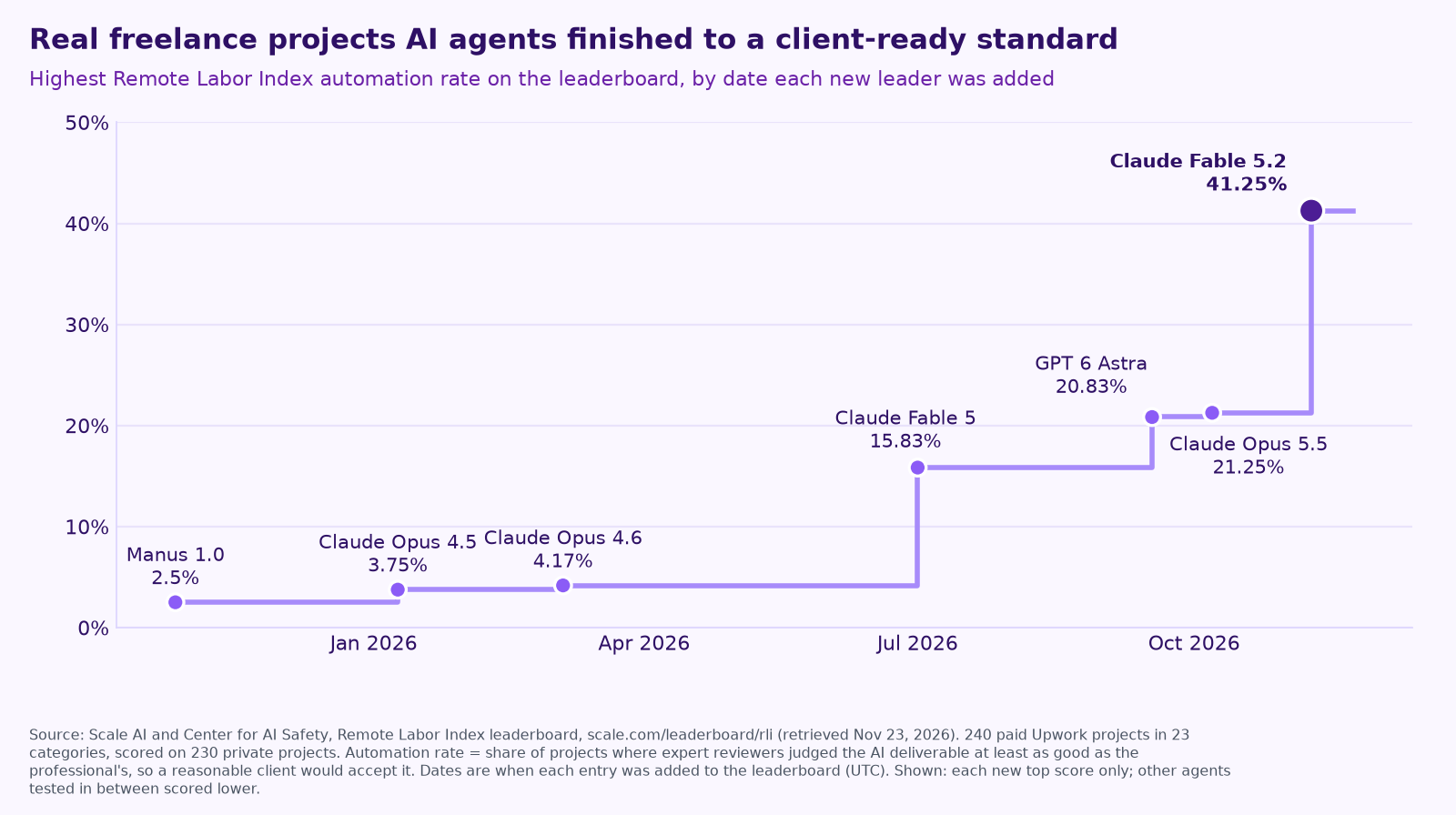
Mollick’s point in sharing it was that AI isn’t only improving at things a computer can grade automatically, like code and math. It’s also improving at work that people have to judge:
Yes, it is reasonable to expect AI models struggle more with unverifiable domains, but I do think it is worth noting that we also see very large gains in domains without automatic verification as well.
Here are human evaluations of AI in writing, business problems, design, etc.
— Ethan Mollick (@emollick) November 22, 2026
Read the number carefully
41% is a big jump. It’s also a number with fine print, and the fine print is where your decisions live.
The one idea to remember
41% done means 59% not done, and the agent doesn’t always know which is which. The value you get from an AI agent depends less on how often it succeeds and more on how fast you can tell when it didn’t.
A few things the test deliberately leaves out, according to Scale’s own write-up:
- No customer conversations. Projects that need direct client interaction, like customer service, were excluded.
- No physical work. Nothing that needs hands on a job site.
- No long-term results. Work judged over months, like SEO, wasn’t included.
- One shot, small budget. Each agent got the brief, the files and up to $30 of AI usage per project. No back-and-forth with a client, no second round of edits.
That last point cuts both ways. In your business, a person can give feedback and ask for a fix, which should help. But your work also has context the agent doesn’t know, like which customer is touchy or which supplier always ships late.
And the leaders change month to month. Mustafa Suleyman, who runs Microsoft AI, wrote this week that AI capability is “doubling every 3.6 months while it’s getting harder to measure,” pointing to a new research update from the evaluation group METR. A leaderboard tells you the direction. Only a test on your own work tells you whether to change how you operate.
Why the other attempts failed
When the index launched, Scale looked at why agents’ deliverables were rejected. The agents then were much weaker, so the rates below are not today’s. But the kinds of failure are a ready-made checklist for reviewing any AI deliverable:
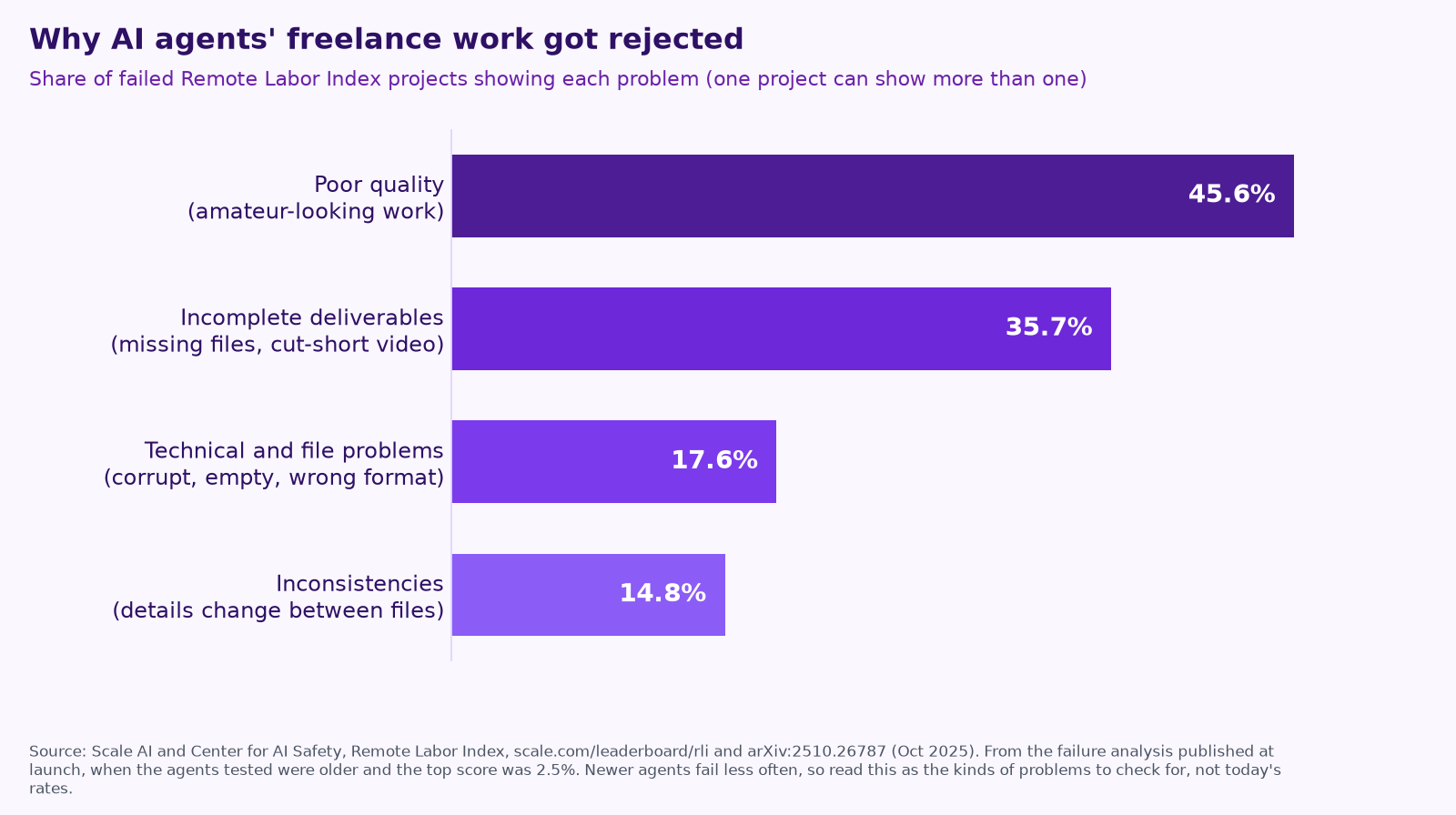
Look at that list as a business owner and it’s familiar. Work that looks amateur. Work that’s missing a piece. A file that won’t open. A floor plan where, in Scale’s example, the house’s design changes between different 3D views. Three of those four are things a careful person can catch in a few minutes, if they know to look.
Scale also noted where the early successes clustered: audio work, images like logos and ads, report writing, and finding and pulling together data. Those are areas where “is this right?” is relatively fast to answer.
What this means for a small business
One reply to Mollick’s chart put the shift well: “Unverifiable mostly means expensive to verify” (@tallmetommy). For an owner, that turns a vague question into a concrete one. Instead of “can AI do our marketing?” ask “if an agent drafted this, how long would it take us to know it’s right?”
| Kind of work | How fast can a person check it? | Sensible way to use an agent |
|---|---|---|
| A job-completion report from photos and crew notes | Minutes, if the person was on the job | Agent drafts; the foreman or PM signs |
| Social graphics or ad variations | At a glance | Agent makes options; someone picks and posts |
| Pulling numbers from invoices or bids into a sheet | Fast with spot-checks and totals | Agent fills it; a person checks totals against the source |
| A new estimate or price | Slow; needs real expertise | Agent gathers inputs; a person owns the number |
| Live customer conversations | Not covered by this test | Drafts or clear rules, with a person on anything that matters |
Notice the pattern. The best first jobs for an agent aren’t the easiest ones. They’re the ones where your team already knows what good looks like.
Try it on your own work: a one-project test
You can borrow the RLI’s method without a research budget. One reply suggested exactly this: run one brief through an agent next to the person doing it, and compare before moving any budget (@shivanathd).
- Pick a project you’ve already paid for. A brochure, a monthly report, a proposal packet, a set of listing photos with descriptions. The finished version is your answer key, just like the professional’s deliverable in the RLI.
- Write the brief like you would for a new freelancer. What it’s for, who reads it, which files to use, what format you need back. If you can’t write it down, an agent can’t follow it either.
- Let the agent do it once, without coaching. That shows you its real first-draft quality.
- Review it against the four failure types. Is the quality good enough for a customer to see? Is everything there? Do the files open? Do the details match from page to page?
- Time the review, not just the draft. If checking and fixing takes longer than doing it yourself, it’s not a fit yet. Our hours-back method walks through that math.
A quick review checklist
- Would I send this to a customer as-is? If not, what exactly would I change?
- Is every requested piece here (every page, file, size and version)?
- Do the files open on someone else’s computer and phone?
- Do names, dates, numbers and addresses match the source material?
- Does anything look made up, like a figure, a quote or a product feature?
- Who on our team signs off, and do they have time to do it every time?
The hard parts, honestly
Review is real work. The RLI used trained expert reviewers, three per project. In a small company, the reviewer is usually the owner or a senior person whose time is already scarce. If an agent produces ten drafts that each need careful review, you may have just moved the bottleneck.
Good enough is a judgment call. The test’s bar is “a reasonable client would accept it.” Your bar might be higher for a bid going to your biggest customer and lower for an internal summary. Decide that bar per job, before you start.
Almost done is the dangerous zone. Incomplete deliverables were a common failure. An agent can hand back something that looks finished and isn’t. That’s why a short “is everything here?” check belongs in every workflow, not just the first few runs.
Benchmarks aren’t your business. 240 freelance projects can’t capture your customers, your trade or your files. Treat 41% as a reason to run a test, not as a forecast for your shop. And because the top tools change every few months, set things up so you can switch models without rebuilding everything. We covered that in matching the model to the job.
Keep a person in charge. As agents get better, it gets easier to wave things through. The right setup makes the approval step quick, not optional. More on that in our guide to keeping a human in charge of AI agents.
Where Purple AI fits
Purple AI builds and runs AI agent teams for construction and trades businesses, inside the tools you already use. We’ve been building with AI since 2023, and our setups are designed so a person signs off on what matters and nothing important goes out on its own. If you have a project in mind and want to know whether an agent could take a first pass, and how you’d check it, bring it to a free 15-minute AI mini-audit at gopurple.ai.
Sources
- Scale AI and Center for AI Safety, Remote Labor Index (RLI) leaderboard and methodology (retrieved Nov 23, 2026).
- Mantas Mazeika et al., Remote Labor Index: Measuring AI Automation of Remote Work, arXiv:2510.26787 (Oct 2025). Paper page: scale.com/research/rli.
- Ethan Mollick (@emollick), post on X with human-judged AI performance charts (Nov 22, 2026).
- Mustafa Suleyman (@mustafasuleyman), post on X about measuring AI capabilities (Nov 21, 2026), quoting METR’s research update (Nov 20, 2026).
- @tallmetommy, reply on X about the cost of verification (Nov 22, 2026).
- @shivanathd, reply on X about testing an agent side by side (Nov 22, 2026).
Free checklist
Find 10 hours a week: the AI checklist for contractors
30 places construction and trades businesses lose time every week, and what an AI agent can take off your plate. On the page or as a printable PDF.
Get the checklist →
