
Some of your next customers won’t visit your website themselves. They’ll send an AI agent to do it for them. That stopped being a prediction this month. Stripe says spending through the wallet that powers personal AI agents like Muse, Instinct and Grok grew nearly 80-fold between early September and mid-November. And on Monday, a16z published the most detailed look yet at how those agents decide what to buy, based on 11,307 test runs.
The findings are surprisingly down-to-earth. The agents didn’t care much about clever branding. They cared about the price, the reviews, whether the thing was in stock, what the return policy said, and whether they could finish checking out without creating an account.
The practical thesis: an AI agent can only choose you if it can read the facts a careful buyer needs, quickly, on a page it can reach. Most small business websites hide those facts behind “call for pricing,” a PDF, or a login. Fixing that is cheap, it helps your human customers too, and it’s the part of this shift you actually control. Here’s what the new research says, what it doesn’t, and a checklist you can work through this week.
What’s actually happening
A “personal agent” is an AI assistant that doesn’t just answer questions but does errands: it searches, compares, fills in forms and, with your approval, pays. Think of it as sending a very fast, very literal assistant to the store with your shopping list.
Three things landed in the last few days:
- The spending is real and growing. Stripe’s Ernie Tedeschi reported that daily spend on Stripe’s Link Agent Wallet was nearly 80 times higher in mid-November than at the start of September, and doubled in the last month alone. Over 40% went to airfare, travel and lodging, roughly a third to retail. More than half of people who made one agent purchase came back for a second. Stripe CEO Patrick Collison put it simply:
Agentic commerce is growing extremely quickly.
— Patrick Collison (@patrickc) November 22, 2026
- Big platforms are opening doors. OpenAI launched Businesses in ChatGPT on Nov 10, letting businesses claim a profile, keep details current and add product feeds with pricing and availability. Walmart is rolling out an Agent Gateway that lets Meta’s Muse shop on a customer’s behalf, with spending limits and purchase approvals (The Verge reports Walmart moved the launch to today, Nov 24).
- We finally have test data on how agents choose. a16z partners Olivia and Justine Moore worked with The Prompting Company to run four personal agents (Grok Bot, Muse, Instinct and Dots) through 1,270 shopping and software prompts between Oct 22 and Nov 8.
Agents are the next big distribution channel for products, services, and software.
But how do they decide what to recommend?
@omooretweets and I did a deep dive with @promptingco – and we're sharing takeaways after running 11k+ agent tests 👇
— Justine Moore (@venturetwins) November 23, 2026
How AI shopping agents decide
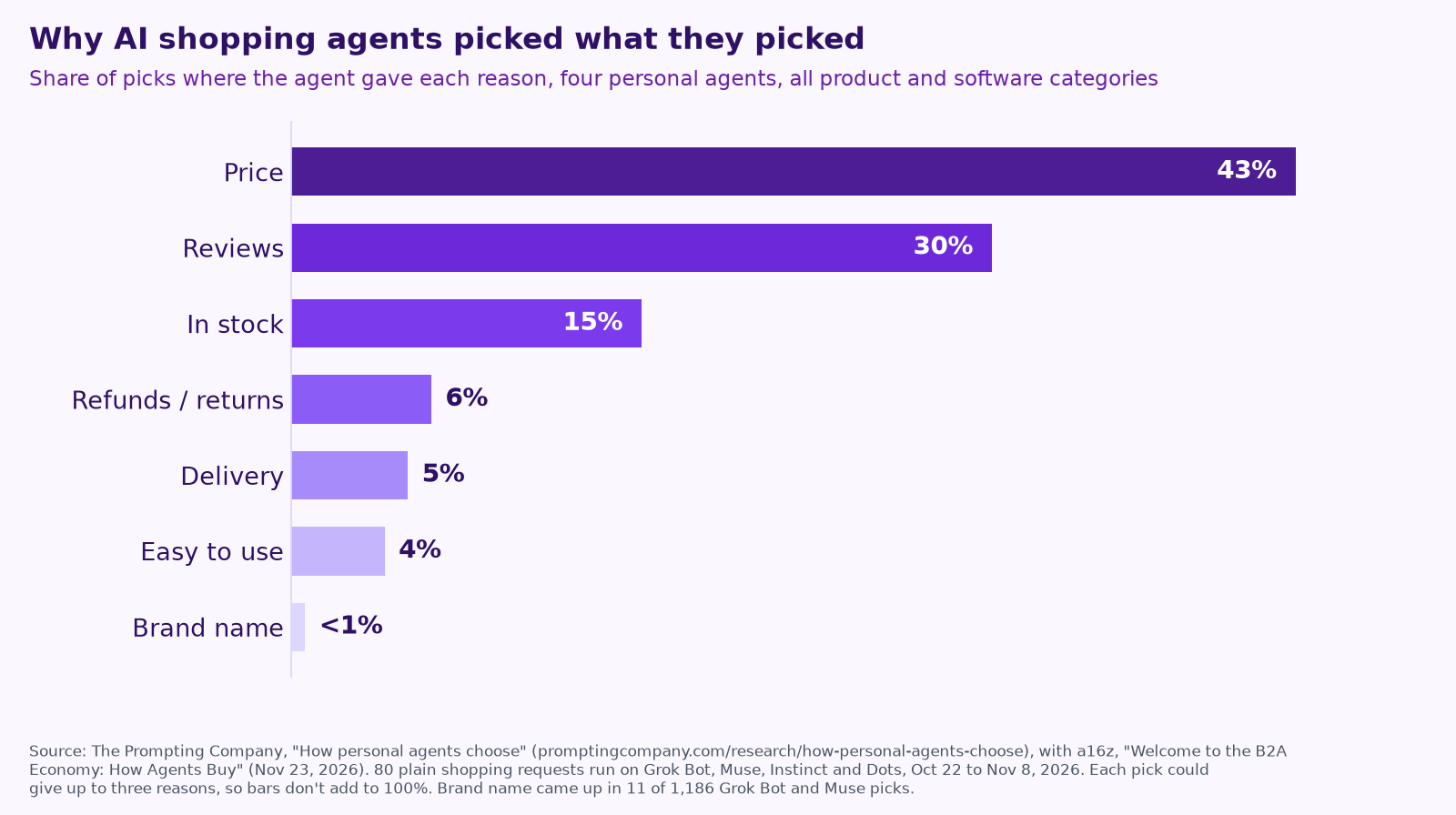
When the agents explained their picks, price came up most, then reviews, then stock. Brand name barely registered: it came up in just 11 of 1,186 Grok Bot and Muse picks.
A few details from the a16z write-up matter for any business:
The shortlist is short
Muse, the only agent that showed its full research log, almost always started with Meta’s own catalog and pulled at most 50 options. When it also browsed the web, it looked at about three product pages on average. The agents also agreed with each other a lot: a product picked by one had a 73% chance of being picked by another. If an agent can’t find and read your page in that first quick pass, you’re not in the running.
Specific needs beat general popularity
Asked plainly to choose between a Shark and a Dyson hair tool, agents picked the cheaper Shark 91% of the time. Told the buyer would use it every day, the Dyson won 88% of the time. Asked for design software, agents picked Canva by default; ask for pro-level print work and Adobe won every time. The lesson for a small business: say exactly who you’re best for and why, in plain words. “Same-day water heater replacement in the west metro” gives an agent something to match. “Quality service you can trust” doesn’t.
Agents do the math, including the fine print
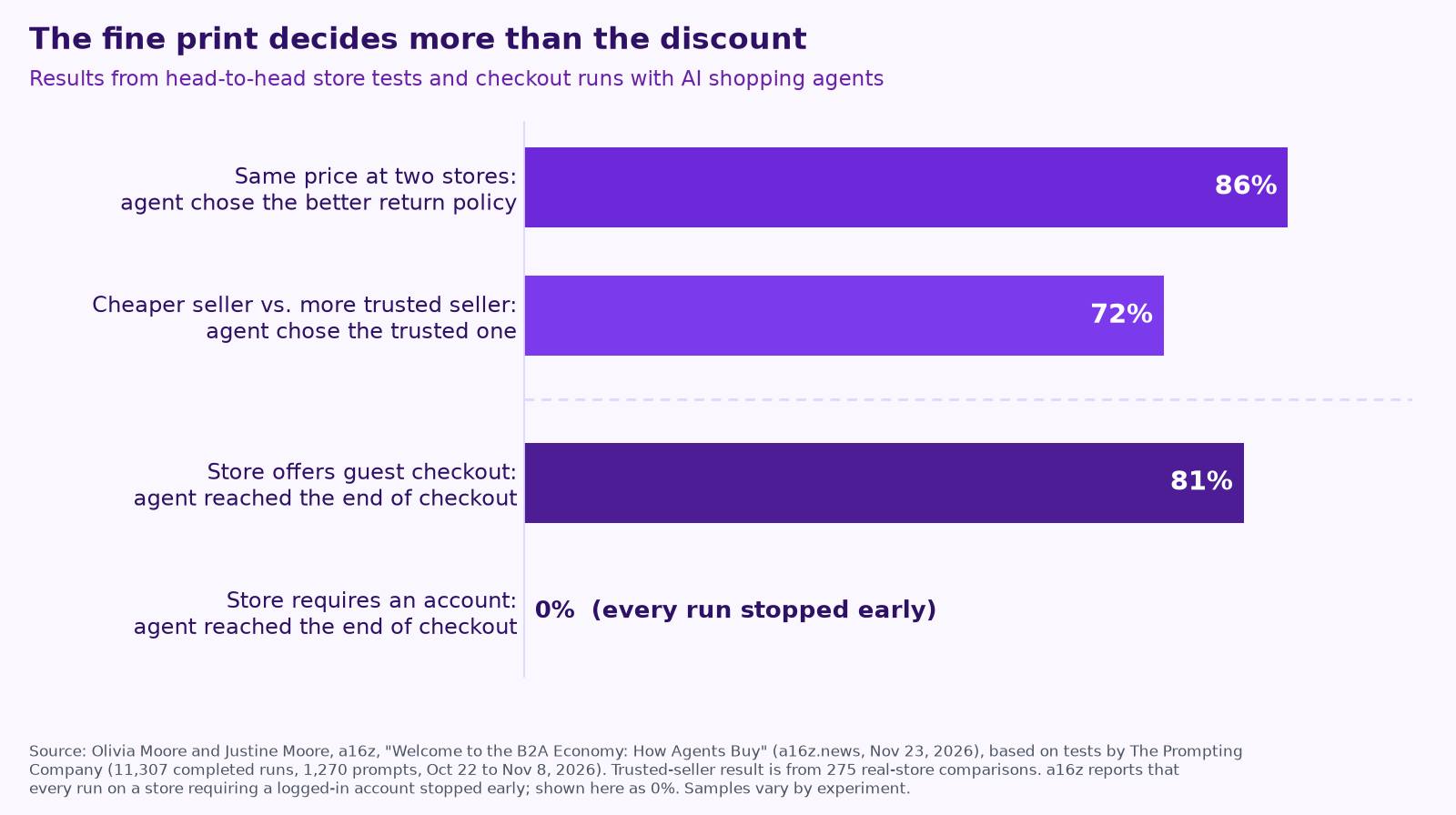
The agents added up shipping, subscription terms, return windows and warranties. When two stores had the same price, they chose the one with the better return policy 86% of the time. Trust counts too: across 275 comparisons of a cheaper seller against a more trusted one, agents chose the trusted seller 72% of the time. A less-trusted seller’s discount of under 10% didn’t sway them at all, and past 50% off they steered clear.
Login walls stop them cold
On stores that offered guest checkout, agents reached the end of the checkout form in 81% of runs. On stores that required an account, every run stopped early, sometimes to ask the user for a password and sometimes by simply going to another store.
In plain terms
An AI agent shops like your most careful customer, with no patience. It wants the price, the reviews, what’s included, what happens if something goes wrong, and a way to say yes. If it has to call you, download a PDF or make an account to learn those things, it usually moves on to someone it can read.
What this means if you sell services, not products
Be honest about the limits here: these tests were about products and software, and most agent spending so far is travel and retail. Nobody has published comparable data for plumbers, remodelers or accounting firms yet.
But the logic carries over. When someone asks an agent to “find a licensed electrician near me who can install an EV charger this week,” the agent can only weigh what it can read: your services, service area, hours, rough pricing, reviews, licensing and how to book. a16z’s Olivia Moore also noted on X that agents first check what they remember about the user’s preferences before they search, which means the customer’s own specific needs will shape the shortlist even more.
Here’s how the findings translate to a typical small business website:
| What the agent checks | What the tests found | What to put on your site |
|---|---|---|
| Price | The reason cited most (43% of picks) | Starting prices, typical ranges or a clear service-call fee, in text on the page |
| Reviews and trust | Second most cited; trusted seller won 72% of the time | Review count and rating, licenses, insurance, years in business, warranty |
| Fit for a specific need | Specific needs flipped the default pick | One clear page per service, saying who it’s for and what’s included |
| Policies | Better return policy won 86% of same-price tests | Cancellation, rescheduling, guarantee and payment terms in plain words |
| A way to say yes | Guest checkout 81% finished; login walls 0% | Booking or quote request that works without an account, with clear next steps |
The hard parts nobody should gloss over
The people publishing this data have a stake in it. The Prompting Company sells tools to help businesses get picked by AI agents, and a16z invests in the space and says so in the article. That doesn’t make the numbers wrong, but it’s a reason to treat them as early signals rather than settled fact.
Every agent behaves differently. In the tests, Grok Bot linked to Amazon in 17.5% of runs while no other agent topped 1.6%; Muse leaned on Walmart and Best Buy. There’s no single trick that works everywhere, which is another reason to focus on clear facts rather than gaming any one system.
Big platforms want to sit in the middle. Analyst Eric Seufert pointed out that Walmart’s gateway routes outside agents through Walmart’s own assistant, which also shows sponsored prompts:
Reminder that Walmart’s Agent Gateway routes third-party agent requests *through Walmart’s own agent*, Sparky. Third-party agents are essentially relegated to relaying Sparky output. Walmart retains account-level payment control and its first-party customer relationship.
— Eric Seufert (@eric_seufert) November 23, 2026
For a small business that means your own website, your reviews and your listings on the platforms your customers already use all matter, and you won’t control all of them.
You can’t measure much of this yet. Standard website analytics weren’t designed to show what an agent read on your site or why it left. Expect to learn by testing, not from a dashboard.
Don’t throw out what works for people. Everything on the checklist below also helps the human who visits your site at 9 p.m. comparing three contractors. That’s the safest bet: it pays off whether agent traffic grows fast or slowly.
A checklist you can do this week
- Run the agent test. Ask two or three AI assistants to find a business like yours in your area for a specific job. Note who they pick, why, and what they say about you.
- Put prices in plain text. Starting prices, ranges or a service-call fee. If you truly can’t, explain what the price depends on.
- Write one page per service that says who it’s for, what’s included and how long it takes.
- Show your proof: review count and rating, licenses, insurance, warranties, years in business.
- Spell out your policies: cancellations, rescheduling, guarantees, payment terms.
- Keep key facts out of images and PDFs. Hours, service area and prices should be readable text.
- Remove the login wall from booking, quotes or checkout. Guest options first.
- Update the profiles agents read, such as your Google Business Profile, and consider claiming your business in ChatGPT if you’re eligible.
- Don’t count on small discounts. In the tests, under 10% off from a less-trusted seller didn’t move the agent. Trust and clear terms did.
- Re-run the test monthly and keep notes. Agents change quickly.
For more on how AI is changing the way people find businesses, see our earlier post on winning at search in the age of AI.
How Purple AI can help
Making a website clear, findable and easy to act on is the everyday work of our Web & Growth Studio. Forge builds your site, Hone handles weekly SEO with pages optimized for AI Overviews and a person approving every change, and Lift runs a 25-point conversion audit on every page each week. Each starts at $500, and you own everything. We’ve been building with AI since 2023. If you’d like a second set of eyes on whether an AI agent can read your site, start at gopurple.ai or see the Web & Growth Studio.
Sources
- Olivia Moore and Justine Moore, a16z, Welcome to the B2A Economy: How Agents Buy (Nov 23, 2026).
- The Prompting Company, How personal agents choose (data tables and methodology, retrieved Nov 24, 2026).
- Olivia Moore and Justine Moore, a16z, Welcome to the B2A Economy (Nov 11, 2026).
- Ernie Tedeschi (@ernietedeschi), Stripe, The agentic story on the eve of the 2026 holiday season (X article, Nov 20, 2026).
- Patrick Collison (@patrickc), post on X (Nov 22, 2026).
- Justine Moore (@venturetwins), post on X announcing the study (Nov 23, 2026); Olivia Moore (@omooretweets), reply on agent memory (Nov 23, 2026).
- OpenAI, Introducing Businesses in ChatGPT (Nov 10, 2026; updated Nov 19, 2026).
- The Verge, Meta Muse can now do your Black Friday shopping at Walmart (Nov 23, 2026).
- Eric Seufert (@eric_seufert), post on X about Walmart’s Agent Gateway (Nov 23, 2026).
- Stripe, Stripe helps Muse, Meta’s new personal AI agent, shop across the internet with Link.
Free checklist
Find 10 hours a week: the AI checklist for contractors
30 places construction and trades businesses lose time every week, and what an AI agent can take off your plate. On the page or as a printable PDF.
Get the checklist →
